Get Full Government Meeting Transcripts, Videos, & Alerts Forever!
Get email alerts on the Working Connections topic
No spam. Unsubscribe anytime.
State’s attendance-based changes to child-care subsidies aim to cut costs, providers warn of harm
Summary
The Department of Children, Youth, and Families outlined how House Bill 2689 changes to Working Connections Child Care—including a daily attendance payment policy—are projected to save the state roughly $91 million in 2027 and about $253 million annually thereafter, while providers say the policy may incentivize disenrolling irregularly attending vulnerable children.
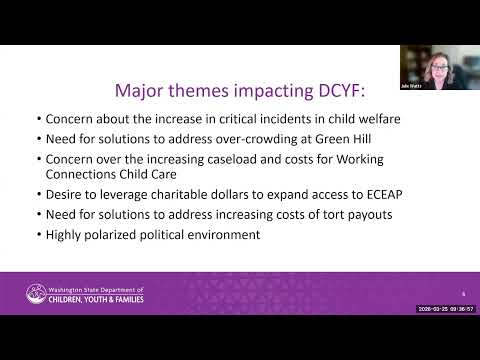
Barbara Serrano, Chief Public Affairs Officer for the Department of Children, Youth, and Families, and Brienne Bogs, the agency’s Deputy Chief Financial Officer, told a public webinar that the conference budget includes policy changes to the Working Connections Child Care subsidy program under House Bill 2689 and that implementation questions remain.
Brienne Bogs said the bill adopts a daily attendance policy that "limits the number of days a provider can claim for payment based on the child's attendance if the child attends 15 or fewer days in the calendar month." She told listeners the conference budget shows "a cost savings in the conference budget of $91 million in 2027 and an assumed savings of 253 million annually in fiscal year 28 and 29." (Brienne Bogs, Deputy Chief Financial Officer.)
Julie Watts, Deputy Director of Government Affairs, and agency staff said other HB 2689 provisions change subsidy and market-rate rules: the child-care subsidy base rate will continue to be adjusted to the 85th percentile in July 2026, but a planned future increase was adjusted to the 75th percentile for July 1, 2027; the market-rate survey will require region response-rate thresholds (40% minimum and special maintenance at 65%); and the bill removed enhanced regional rates for Benton, Clark, Walla Walla and Whitman counties.
Providers who submitted questions at the webinar said the attendance policy could harm children who attend irregularly, such as split-household children, foster children, or kids who miss days for illness or custody arrangements. In response, Barbara Serrano said the department is "still analyzing the impact of the bill" and that detailed implementation guidance will be provided in follow-up webinars in late April or early May.
Speakers also acknowledged the bill includes funding for implementation: Brienne said the conference budget provides staffing to support audits, IT changes and program support and funds 14.5 full-time equivalent positions in fiscal year 2027 to carry out implementation tasks.
The department emphasized it does not make legislative decisions and encouraged providers with concerns about the policy's effect on vulnerable children to contact their state legislators and members of the Early Learning and Human Services Committee. The agency said it will solicit provider input during the implementation process and post additional guidance online and in follow-up webinars.