Get email alerts on the Energy Code Rulemaking topic
No spam. Unsubscribe anytime.
Building Code Council sets CR102 schedule for energy-code rulemaking, public hearings in June
Summary
SBCC staff told the council the energy-code CR102 filing is targeted after the April meeting with a May 6 code‑revisor deadline; hearings are planned June 9–12, workshops June 12–Aug 21, final-adoption motion targeted for Aug 21, and implementation set for May 3, 2027.
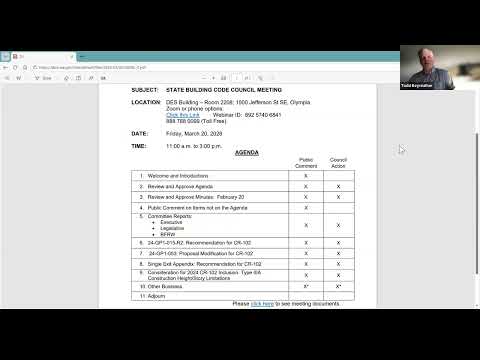
The Washington State Building Code Council on March 20 received a timeline for statewide energy‑code rulemaking and approval steps. SBCC staff told the council the agency plans to file CR102 after the April council meeting with a code‑revisor deadline of May 6; the Washington State Register will publish the filing two weeks later and hearings are scheduled June 9–12. Staff said written public comment and signups for oral comment will be accepted, and workshops are planned June 12 through Aug. 21.
"We are looking to do our CR102 filing after our April Council meeting," staff said, noting the target dates. The council heard that staff aims to bring a motion for final adoption at the Aug. 21 meeting, with a final filing target of Sept. 2 and an implementation date set at May 3, 2027 (the first business day in May after the 2027 legislative session ends).
Why it matters: The CR102 filing opens the formal public-rulemaking process for the energy code, triggering published documents, the public‑comment period, and the hearing schedule that stakeholders use to submit technical and policy input. Council members said the schedule will shape when technical advisory groups can refine cost‑benefit analyses and prepare staff materials.
What happens next: Staff will prepare the CR102 package for the April council meeting and publish the materials after the code‑revisor deadline. The council may modify proposed language after public comment during the CR103 process, and any substantive post‑comment changes could require further public-notice steps under the Administrative Procedure Act.
AI generated
The text on this page is AI generated. Summaries, highlights, analysis, and video transcripts are all produced from the original source material.
AI can make mistakes, so if you spot one, and we will fix it for everyone.
Note: the source content is unaltered by us. Any content source we link to, be it a video, an audio recording, or a document, is presented exactly as its publisher released it. That publisher is usually a government body, sometimes an individual official or another organisation.