Get Full Government Meeting Transcripts, Videos, & Alerts Forever!
Get email alerts on the Housing topic
No spam. Unsubscribe anytime.
McCall directs staff to advance 30–40 unit affordable housing plan with LEAP Housing on city land
Summary
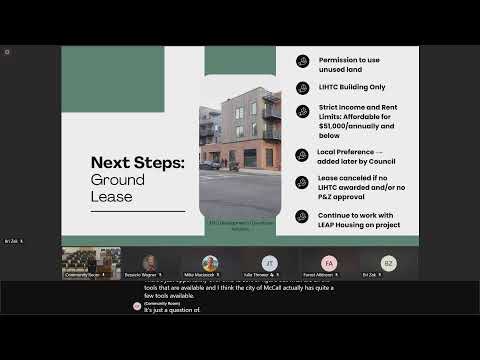
The council gave staff direction to pursue a Low Income Tax Credit rental project on underutilized city campus land, endorsing a ground lease approach to enable LEAP Housing to apply for tax credits and noting sewer capacity for up to 40 units.
The McCall City Council directed staff to continue work on a proposed 30–40 unit affordable rental project on city‑owned campus land and signaled broad support for using a long‑term ground lease to enable LEAP Housing to pursue Low Income Housing Tax Credits (LITC).
Housing Program Manager Brie Zach briefed the council on prior direction and feasibility work. She said the Flynn Lane home‑ownership site is constrained by sewer connection limits (only three sewer hookups available, reducing potential units), and recommended shifting focus to a northwest corner of the civic campus that is underutilized and well‑located near services.
Zach reported Pay Lakes Recreation Water and Sewer District ran a sewer model indicating capacity to add up to 40 units on the proposed city campus site, and noted LEAP Housing brings experience in competitive LITC applications. She said legal advice favored a long‑term ground lease under Idaho Code 50‑1407 as the fastest, most policy‑sound path to make city land available for development without an RFP.
Council members generally praised the proposal and the LEAP partnership, and stressed the importance of long‑term affordability controls. Zach said a 75‑year ground lease is being contemplated to ensure the affordability covenant persists through ownership changes, and the likely unit mix would target households at or below 60 percent area median income.
Council direction was recorded as consensus to continue advancing the project and to return draft ground‑lease language and application materials to council for review. Staff emphasized that a ground lease would not guarantee award of tax credits but would allow the developer to apply; the project still requires competitive LITC award, planning approvals, and financing.
Council members also asked staff to continue exploring smaller infill home‑ownership options (Flynn Lane) and multiple funding stacks, but agreed the LITC rental approach addresses a pressing local need for workforce housing.
The council did not vote on a lease at the meeting; rather, members provided direction to staff to move forward with negotiated ground‑lease terms and developer coordination.