Get Full Government Meeting Transcripts, Videos, & Alerts Forever!
Get email alerts on the Graduation Requirements topic
No spam. Unsubscribe anytime.
Public witnesses urge flexibility, endorsements and financial-literacy courses as board reviews graduation changes
Summary
During public testimony the State Board heard proposals and cautions on revised high-school graduation requirements. Advocates recommended optional endorsements, flexible scheduling for postsecondary touchpoints, caution on mandatory capstones and support for a half-credit financial literacy course or competency-based alternatives.
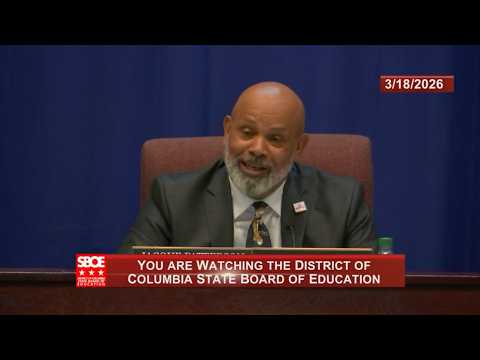
Public testimony at the March 18 State Board meeting focused heavily on proposed changes to high-school graduation requirements and on how those changes affect equity and student opportunity.
Several witnesses — representing charter networks, nonprofit advocates and a coalition of financial counselors — urged the board and the Office of the State Superintendent of Education to preserve clarity and equity as the district rethinks requirements such as endorsements, capstones and postsecondary touchpoints.
Noah Dhorty of the DC Charter School Alliance said his organization supports endorsement options and recommended explicit optionality for both local education agencies (LEAs) and students, arguing that endorsements should reflect each school’s programmatic strengths rather than being uniformly required. He recommended flexible timing for postsecondary touchpoints and cautioned that a required capstone project would be resource intensive and could create inequitable access without additional funding and guidance.
Advocates including Ariel Levenson Waldman of SE:DC and Melissa Mazard (a financial counselor) strongly backed including financial literacy in graduation requirements. Ariel told the board she and her organization support "the proposed graduation requirement of a half-credit financial literacy semester-long course" while also encouraging implementation that ensures equitable access. Melissa Mazard told the board students are eager to learn about practical money skills and described financial education as foundational to later economic stability.
Other public witnesses and experts suggested multiple implementation paths: a standalone personal-finance course, integration of financial standards across existing courses (math, economics, advisory periods), or competency-based options where students demonstrate mastery. Several witnesses emphasized that any new requirement must be accompanied by funding, training and clear guidance to ensure equitable access, particularly for schools with constrained staffing and schedules.
What’s next: witnesses recommended the board pause to review longitudinal data (including an upcoming education-to-employment pathways database) and to ensure guidance and funding accompany any new graduation requirement so that schools can implement changes without reducing other instructional time.
Key quotes from testimony included calls for clarity and resources. "We support the creation of endorsement options and believe that clarity is critical," a representative of the charter-school alliance said. "We support the proposed graduation requirement of a half credit financial literacy semester-long course," an advocate for financial education told the board.