Get Full Government Meeting Transcripts, Videos, & Alerts Forever!
Get email alerts on the Health And Human Services topic
No spam. Unsubscribe anytime.
Morrison County HHS reports rising long‑term care assessments; staff warn of possible $270,000 county cost shift
Summary
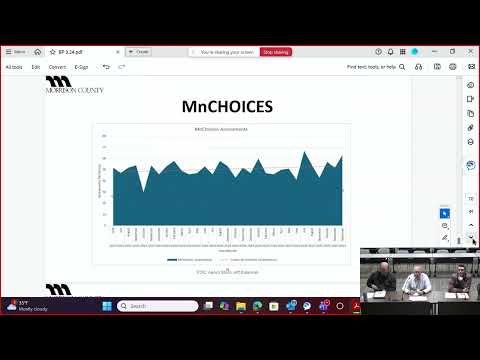
Health & Human Services told the county board that Mn‑choice/waiver assessments have risen — staff completed 631 assessments in 2025 and said a state fiscal review could shift roughly $270,000 in costs to Morrison County if lawmakers do not identify savings.
Health and Human Services staff on March 24 told the Morrison County Board of Commissioners that demand for long‑term care assessments has risen and that a pending state review could produce a preliminary county cost exposure of roughly $270,000.
Nathan Bertram, Health & Human Services director, introduced the presentation and said the county is combining its Mn‑choice and waiver reports to reflect how assessment results drive waiver eligibility. Aaron Stein, human services supervisor, described the assessment as “a comprehensive assessment that helps people with long‑term or chronic care needs make decisions and select support and service options.”
Staff reported that the department completed 631 Mn‑choice assessments in 2025 with four full‑time assessors averaging just over 11 assessments per month, consistent with state workload guidance. An intermittent part‑time assessor pool — four current intermittent staff — handled 74 assessments in 2025, which presenters said stabilized workloads and supported staff retention.
Jeff Bowman, adult services supervisor, detailed the county’s waiver programs (elderly waivers and disability waivers including community alternative care, CADI, brain injury and developmental disability waivers), explaining that assessments determine both eligibility and the budgeted level of services. Bertram stressed the county acts as a pass‑through for waiver funding and that the county’s case‑management revenue rises as client counts increase.
On legislation, staff summarized a state council charged with finding $178 million in savings by a 2027 report; Bertram said that, under early projections, a county cost shift could be roughly $270,000 for Morrison County but described that figure as preliminary and subject to legislative outcomes. “Right now early projections if that cost shift were to happen roughly 270,000 would be Morrison County’s cost share,” Bertram said.
Commissioners pressed staff on spikes and declines in authorized waiver allocations. When Commissioner Winer asked whether earlier swings had anything to do with fraud, staff replied the variances reflected state allocation and utilization patterns, not fraud. Commissioners also asked about residency and eligibility timing; staff said new residents may be eligible, but counties of origin can retain responsibility for recent arrivals and that Mn‑choice assessors aim to complete initial assessments within about 20 business days, with certification steps taking longer in some cases.
The board received the report and discussed monitoring legislative developments and staffing plans. Staff and the board praised the intermittent part‑time assessor pool as a cost‑effective approach to manage workload peaks and preserve service quality.
Next steps: staff will continue to monitor state legislative activity and report back on any formal proposals that could affect county finances or program structure.