Get Full Government Meeting Transcripts, Videos, & Alerts Forever!
Get email alerts on the Energy topic
No spam. Unsubscribe anytime.
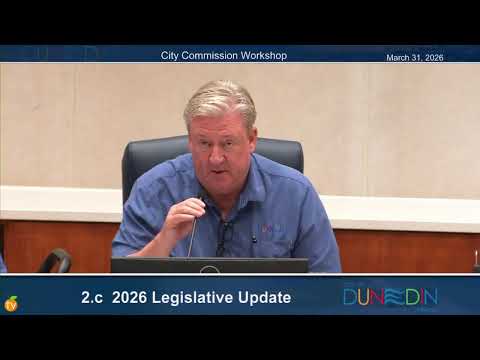
Duke Energy tells Duneden leaders reliability is improving but solar subscription raises long-term payback concerns
Summary
Duke Energy briefed the commission on its storm-protection investments and vegetation program, credited infrastructure upgrades with recent reliability gains, and outlined Duneden—s participation in the Clean Energy Connection solar subscription; residents and commissioners pressed Duke over communications, undergrounding, and the program—s capacity-factor-driven payback estimates.
Duke Energy representatives told Duneden—s commission that targeted investments under the company—s Florida storm-protection plan — including feeder and lateral hardening, pole and device replacement, and segments of undergrounding — have reduced equipment-related outages and shortened average outage durations in the city.
Stephano Carneo, Duke—s director of asset management for distribution, described the program—s technical approach: "If you think of the distribution grid as a tree, the feeder is the trunk of the tree— the lateral are like the branches," he said, explaining feeder hardening, lateral hardening and "the self-optimizing grid" devices that isolate and restore small segments automatically. Duke presented five-year performance metrics that, the company said, show Duneden performing better than its statewide averages on industry-standard indices for outage frequency and duration.
Duke—s vegetation-management lead, Nick Espazito, told the commission the utility trims main lines on a three-year cycle and laterals on a five-year cycle; transmission corridors are flown and removed where necessary, and the company said it uses door hangers, QR codes, and targeted digital notices to inform affected customers. He warned against planting palms directly beneath lines because trimming options are limited.
Commissioners sought more coordination with the city—s tree giveaway, stronger contractor outreach and clearer expectations about easement access and lawn/sidewalk impacts during undergrounding projects. Duke said it routinely provides door-hanger notifications and has a local operations point of contact for homeowner concerns.
Clean Energy Connection: subscription, credits and concerns
Travis Nouse, program manager for Duke—s Clean Energy Connection (CEC), described the voluntary, tariff-backed subscription that allows municipalities and customers to buy an allocated share of a statewide solar portfolio. Duneden originally requested roughly 7.3 MW but now retains an adjusted subscription of about 2,960 kW (roughly 3 MW) after the program—s initial allocation was scaled to allow broader participation.
Nouse said the subscription model charges a fixed per-kilowatt monthly fee ($8.35 per kW in the tariff) and returns generation credits and renewable-energy certificates (RECs) tied to the city—s share of the portfolio. Duke showed that as more portfolio sites came online and initial equipment and warranty problems were resolved, generation and credits rose toward the expected seasonal range.
On the city—s bottom line, Nouse said Duneden had paid roughly $81,000 into the program to date while receiving generation credits that reduced net costs; he illustrated an early partial-year example in which a $37,000 subscription produced $28,000 in credits, lowering the net outlay. Based on Duke—s current capacity-factor assumptions (the percent of expected generation), the utility projected a break-even in roughly 9—3 years and a 17'4-year payback window for the subscription under modeled scenarios.
Capacity-factor dispute and public comment
Sierra Club volunteer Alan Brand told the commission his analysis showed the program sits "on a knife edge." Brand said he was told at program launch to expect 5—-year paybacks; with current portfolio capacity factors closer to 26.6% rather than the 28% used in some initial models, Brand said payback estimates have stretched to 17'4 years. "That's a big difference," Brand told the commission.
Travis Nouse and other Duke presenters said the portfolio—s capacity factor has been rising steadily since earlier equipment and post-hurricane problems and that recent months show improved performance; Duke said it expects further gains and is taking operational steps (more sites, in-house warranty repairs, better parts, dashboards and drones for faster response) to recover the modeled performance.
City sustainability context and next steps
City sustainability staff said the CEC subscription made up about 31% of Duneden—s municipal clean-energy mix in 2024 and complements on-site solar projects the city has installed on several municipal buildings. Staff said they will continue to track generator performance and will request additional information from Duke on how the monthly trailing 12-month capacity factor is trending and how storm and major-event performance would be represented in city figures.
No formal city action was taken; commissioners asked Duke for more detailed outage and storm-performance data, maps of work locations, and a breakdown of how different program scenarios would change the city—s multi-year budget picture. Duke agreed to provide follow-up materials and to work with city staff on outreach materials for tree giveaways and public notifications.