Get Full Government Meeting Transcripts, Videos, & Alerts Forever!
Get email alerts on the Transportation Infrastructure topic
No spam. Unsubscribe anytime.
Campbell study narrows SR‑17 Hamilton Avenue bicycle overcrossing to two grade‑separated options
Summary
Consultants reported that two grade‑separated alignments — a southern route and a Campbell Loop — emerged as the frontrunners in a feasibility study for a bicycle/pedestrian overcrossing of State Route 17 at Hamilton Avenue; two lower‑cost alternatives were dropped from further study. The study will be finalized in December and presented to City Council in February 2026.
City of Campbell staff and a consultant team on Thursday presented a feasibility study that narrows design options for a bicycle-and-pedestrian overcrossing of State Route 17 at Hamilton Avenue to two grade‑separated alignments.
Regina Merrill, a project manager with Circle Point, opened the meeting and said the study will inform the City Council about constructability, Caltrans acceptability and project cost estimates. Matthew Jew of the City of Campbell summarized the project purpose, saying the existing crossing is “challenging to walk or bike” because of freeway ramp traffic and an uninviting environment.
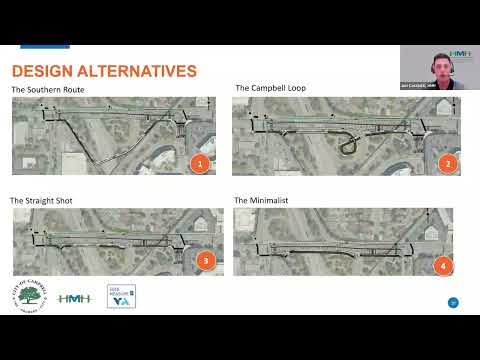
HMH Engineers, the consultant lead, told attendees the team evaluated four alternatives on user experience, traffic impacts, environmental effects, design standards and cost. The consultants reported they received more than 400 survey responses and held an in‑person outreach meeting; respondents rated safety as their top priority, followed by ease of use and connectivity to neighborhoods and schools, with cost and environmental impact scoring lower.
Of the four concepts studied, the team recommended the southern route and the so‑called Campbell Loop for additional study. The southern route would route a class‑one shared‑use path roughly 500 feet south of Hamilton Avenue and would be fully grade‑separated at all ramps, eliminating at‑grade ramp crossings and offering a very gradual 2–3% profile for cyclists and pedestrians. Consultants said the southern route is more circuitous and may lengthen travel paths and would introduce construction challenges adjacent to VTA light‑rail infrastructure.
The Campbell Loop would place a new bicycle/pedestrian bridge south of Hamilton Avenue and route users through the loop of the northbound ramp, providing a more direct alignment and an accessible staircase for pedestrians. The team said the Campbell Loop retains an at‑grade yield crossing of the southbound diagonal on‑ramp and has steeper vertical grades, which could be a disadvantage for some users.
HMH said the straight‑shot alternative and a minimalist option were recommended for discontinuation: the straight shot retains multiple at‑grade crossings of loop ramps that increase conflict points, while the minimalist would rely on lane realignment and a shared path with at‑grade ramp crossings and would not add the westbound bike lane enhancements shown in other alternatives.
Biggs Cardosa Associates presented structural options for a new bridge. The consultants outlined a two‑span concrete box‑girder option (a common Caltrans approach, less expensive but requiring a median column and temporary falsework), a clear‑span steel truss (higher cost and maintenance), and a steel network tied‑arch (the most expensive and highest maintenance but offering a clear span without median columns). The consultants stressed tradeoffs among initial cost, long‑term maintenance, and aesthetic opportunities.
Next steps: the team intends to finalize the feasibility study in December, brief City Council in February 2026, and move to design and construction only if Council authorizes the work and funding becomes available. Presenters said project materials, meeting recording and a follow‑up survey will be posted to the project website for public input.