Get Full Government Meeting Transcripts, Videos, & Alerts Forever!
Get email alerts on the Traffic Safety topic
No spam. Unsubscribe anytime.
San Carlos deputies outline ebike, motorcycle and pedestrian safety at Sept. 15 commission meeting
Summary
San Carlos Sheriff's Office deputies told the Planning and Transportation Commission that many powerful electric two-wheelers are not legal for road use, urged DOT-approved helmets and proper endorsements, and described local 2024 collision figures and planned school outreach and pamphlets funded in part by the Office of Traffic Safety.
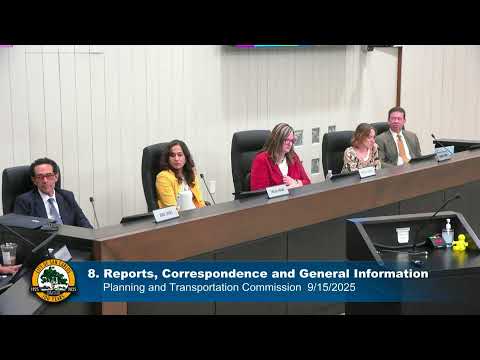
Jerry Cousins, an administrative sergeant with the San Carlos Sheriff's Office, and Deputy Larson told the Planning and Transportation Commission on Sept. 15, 2025, that riders should wear DOT-approved helmets, obtain proper endorsements and avoid alcohol or drugs while operating motorcycles and electric bikes.
The presentation laid out national and local safety data and state rules for electric bicycles. "In 2022, there were 6,218 motorcyclists killed," Deputy Larson said, citing national traffic-safety figures, and he added that a substantial share of single-vehicle motorcycle fatalities involved alcohol. Locally, deputies reported that San Carlos recorded 128 total traffic collisions in 2024, 72 with injuries, one fatal collision involving a bicyclist, nine pedestrian collisions with injuries and three bicyclist injuries; deputies said there were zero DUI fatal collisions and five persons injured in DUI collisions, with seven hit-and-run collisions involving injuries.
Why it matters: ebike and scooter sales have risen while users and parents often lack clear information about which devices are legal on streets, lanes and sidewalks. Deputies said that confusion contributes to unsafe choices and that better public education could reduce crashes.
Deputies outlined California's three ebike classes and related requirements: class 1 and class 2 bikes are throttle- or pedal-assisted up to 20 mph (class 2 may be throttle-only); class 3 pedal-assist bikes can reach up to 28 mph and must display a speedometer and have helmet requirements. Deputy Larson said motorized "pocket bikes" are illegal on roadways and that faster electric motorcycles (examples cited by the presenters included models marketed as Sur-ron) are treated as motorcycles or off-highway vehicles and require registration and an M1 endorsement to operate on public streets.
The presentation emphasized basic safety steps: pre-ride checks (tires, lights, signals), wearing protective gear (DOT- and Snell-approved helmets for motorcycles, properly fitted helmets for bicycles), and passenger briefing for two-up riding. "Be alcohol and drug-free when you are riding on the roadway," Deputy Larson said.
On pedestrian safety, deputies pointed to state law requiring drivers to yield to pedestrians and discouraged bicyclists from riding through crosswalks instead of walking their bikes, saying that a rider on a bike is treated as a vehicle under the Vehicle Code. Deputies described a recent enforcement detail on El Camino that produced dozens of yield-related citations and noted that, at 35 mph, a vehicle needs roughly 154 feet to stop under typical assumptions used by collision investigators.
Commissioners asked about electric unicycles and motorized skateboards. Deputy Larson said the vehicle code allows some motorized boards (longer single-wheel devices) to operate on roadways under skateboard rules but that small one-wheel devices (the type with pegs and a single circular wheel) are not permitted on public roadways and should be confined to private property.
Commissioner Tapias asked how the community could help. Deputies described outreach plans including school presentations, pamphlets and partnerships; they said the Office of Traffic Safety (OTS) is funding some of the outreach work and that school resource officers will help distribute materials.
On legal points deputies cited in the presentation: California Vehicle Code sections discussed included requirements treating bicycles as vehicles when on the roadway (Vehicle Code 21200) and the duty of motorists to yield to pedestrians (Vehicle Code 21950). Deputies confirmed the three-foot passing buffer for motorists remains the rule.
The commission had two routine procedural votes earlier in the meeting: a motion to close public comment and a motion to approve the Sept. 2 minutes; both passed with affirmative votes from the commissioners present.
What happens next: deputies said they will continue school and community outreach, distribute the new pamphlet to local schools and compile materials for further education. The commission will continue to monitor local safety issues and follow City Council actions referenced in the meeting notes.
Votes at a glance
- Motion to close public comment: moved and seconded; outcome: approved (affirmative voice votes recorded by the clerk). - Motion to approve minutes of Sept. 2, 2025: moved and seconded; outcome: approved (affirmative voice votes recorded by the clerk).