Get Full Government Meeting Transcripts, Videos, & Alerts Forever!
Get email alerts on the Municipal Budgeting topic
No spam. Unsubscribe anytime.
Los Gatos council, finance panel study tax and financing options to address future budget gaps
Summary
Town officials reviewed options including a half‑cent transaction/use tax, several parcel‑tax structures and targeted benefit assessments; consultants estimated a 0.5% TUT could raise about $5.3 million annually while parcel‑tax examples ranged from $250 to $3,000 per parcel depending on structure. Council asked staff to post FAQs and await further fiscal studies before deciding on a ballot measure.
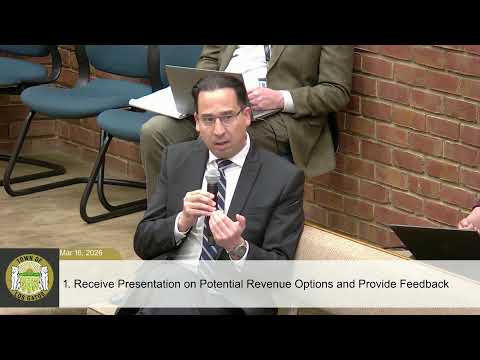
Los Gatos officials on a joint special meeting reviewed a range of revenue and capital‑financing options on a consultant’s recommendation and unanimously approved a staff request to publish FAQs summarizing the study session.
Christine Al Farro, the town’s administrative services director, introduced presenters Wy Fox and Jim Morris of Urban Futures Inc., saying the work is intended to “provide additional information for the finance commission and the town council on revenue options” and not to recommend a specific November measure.
The consulting team framed the discussion around two illustrative targets: a $5 million annual operating revenue goal and a $100 million capital financing example. Consultant Wy Fox said the town’s current combined sales tax is 9.875% and that, in the consultants’ model, an additional half‑cent transaction and use tax (TUT) would generate about $5.3 million annually beginning in fiscal 2027 — but likely would require special legislation to exceed the town’s remaining 0.125% of regional TUT capacity.
“We did not select for further evaluation at this time” every possible tax, Fox said, but noted trade‑offs: sales tax can be volatile year‑to‑year but spreads burden across residents, businesses and visitors; parcel taxes produce steady revenue but require a two‑thirds vote and can be structured in many ways to affect equity.
The consultants presented three parcel‑tax examples to meet the $5 million target: a flat per‑parcel tax (about $445 per parcel), a tiered per‑parcel structure that ranged roughly from $250 to $3,000 depending on parcel size and use, and a per‑square‑foot approach (an example rate of 6¢/sq ft) with a $750 cap so very large parcels would not face extreme bills. Jim Morris explained that the “other residential” category in the model groups parcels with multiple units — condominiums, townhomes or multifamily — and that the model generally relies on parcel size because it was the most readily available dataset.
Consultants also described benefit assessments for geographically targeted services (such as wildfire mitigation) that require an engineer’s report and a mail‑ballot protest process; and they contrasted lease‑revenue bond financings, which are backed by annually appropriated lease payments, with general‑obligation bonds that would appear on the ballot as an ad valorem property tax and require a two‑thirds voter threshold.
On costs and timing, staff said they are pursuing special legislation needed for a larger local TUT if the council chooses that route, and reminded the body that ballot deadlines require decisions by mid‑June to place a measure on the November ballot. Staff gave a prior rough estimate (subject to update) of about $80,000 to place a simple measure on the ballot, not including polling or outreach consulting.
Public commenters pressed two themes: notice and caution. One speaker said the special meeting had limited publicity and called the timing “a little sneaky,” while others urged the council to exhaust cost‑savings and operational efficiencies before asking voters for new revenue. The town attorney clarified that the Brown Act requires 24‑hour notice for a special meeting and that the 10‑day newspaper‑publication rule applies specifically to land‑use decisions; staff said the agenda complied with the Brown Act posting requirement.
Council members and finance commissioners emphasized they were not prepared to place any measure on the ballot immediately. Finance Commission Chair Monk and others said the commission will receive three NHA studies next month — a fiscal condition analysis, a five‑year and long‑term forecast, and a fiscal‑impact analysis — that they expect to use before any final decision. The town manager reiterated that staff’s intent in bringing the consultants’ work forward was to inform the council of the options and timeline rather than to force a fast decision.
Procedurally, Council member Hudis moved (Council member Renie seconded) that staff prepare and post an FAQ summarizing questions and staff answers from this study session; the motion passed unanimously.
Next steps identified by staff include returning NHA’s analyses to the finance commission (deliverables noted for mid‑April in the presentation), posting the updated slide deck and FAQs, and continuing stakeholder outreach and scientific polling if the council wishes to pursue any measure. Staff will also provide a more detailed breakdown of sales‑tax revenue by business sector at the council’s request.
The meeting closed after additional discussion of timing, equity and expenditure prioritization; councilors and commissioners broadly favored further study and public engagement before placing any revenue measure before voters.