Get Full Government Meeting Transcripts, Videos, & Alerts Forever!
Get email alerts on the Housing Element Apr topic
No spam. Unsubscribe anytime.
San Carlos reports modest RHNA progress in 2025; commissioners press for deeper affordable production and clearer tracking
Summary
City staff told the Planning and Transportation Commission the City has approved 70 net new units in 2025 (including the first ADUs counted), with 297 units in entitlement and 41 certificates of occupancy; commissioners expressed concern that very‑low and low income housing production is lagging and asked staff for clearer progress tracking and permit‑velocity metrics.
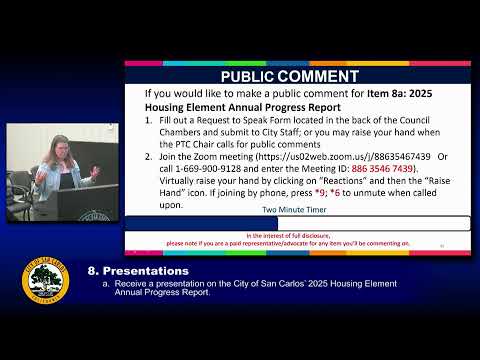
City planning staff presented the City of San Carlos’ 2025 Housing Element Annual Progress Report to the Planning and Transportation Commission on March 16, reporting modest progress toward the city’s Regional Housing Needs Allocation (RHNA) for the 2023–2031 cycle.
Planner Christy Woo summarized the APR: San Carlos’ RHNA allocation for the cycle is 2,735 units across income bands (including two recently added state categories, acutely low and extremely low). For 2025 staff counted 70 net new units (the first year ADUs were included in the city’s tally, representing 27 ADUs this reporting period). Staff also reported 297 units advanced through application/entitlement milestones — 251 of those from a single project at 11 El Camino Real — and 41 certificates of occupancy issued during the year.
Commissioners pressed staff on the distribution of approved units by income band. Commissioners and staff agreed that above‑moderate units account for the largest share of approvals so far, while very low‑ and low‑income unit production lags. Staff noted the city’s inclusionary housing ordinance and other tools (subsidies and incentives) are the primary levers to encourage deeper affordability and said that staff will continue to explore additional strategies and mid‑cycle actions if HCD crediting and market conditions require them.
Multiple commissioners requested improved reporting that shows RHNA progress as a percentage of cycle requirements (for each income band) and asked staff to add performance metrics such as permit processing velocity so the commission can better judge whether the city is on pace to meet its obligations by 2031. Staff agreed to clarify ADU accounting and to provide corrected or more detailed tables for the council presentation next week and for the APR submission to the state Department of Housing and Community Development.
A member of the public, Sonia Elks, urged the city to promote cooperative living, shared‑housing models and tiny‑home options to expand affordable choices.
The APR will be transmitted to City Council and submitted to the state before the April 1 deadline.