Get Full Government Meeting Transcripts, Videos, & Alerts Forever!
Get email alerts on the Community Engagement topic
No spam. Unsubscribe anytime.
Menlo Park advisers propose 'Community Climate Ambassador Team' to broaden Climate Action Plan outreach
Summary
At a March 18 meeting the Environmental Quality Commission’s Community Engagement Ad Hoc Subcommittee proposed a 'Community Climate Ambassador Team' to partner with local organizations, host a kickoff and stakeholder meetings, and use targeted outreach and metrics to accelerate the Climate Action Plan.
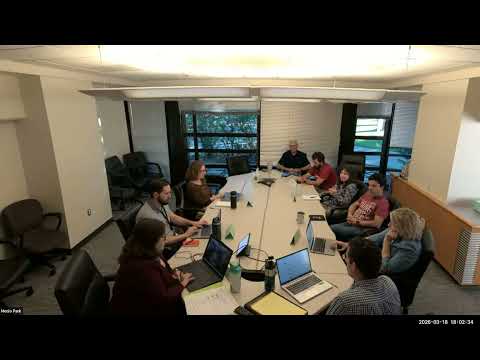
On March 18, 2026, the Menlo Park Environmental Quality Commission’s Community Engagement Ad Hoc Subcommittee outlined a plan to create a Community Climate Ambassador Team (CCAT) to expand outreach and participation in the city’s Climate Action Plan.
Chair McKenna, speaking for the subcommittee, described a hybrid model that starts with a publicly promoted kickoff meeting (potentially on two dates and offered hybrid), followed by stakeholder‑specific meetings led by community groups and quarterly check‑ins by a steering committee. The subcommittee said the idea is to "meet people where they are," using existing trusted community networks to recruit volunteers and leaders rather than relying solely on city‑led meetings.
The proposal identifies an organizing committee that would include city staff, interested EQC commissioners and community organizations to set up the kickoff, design outreach materials, and propose metrics for each stakeholder group. Suggested partners and stakeholders include Peninsula Clean Energy, realty and contractor associations, neighborhood homeowners associations, schools and PTA groups, 350 Silicon Valley’s Menlo Park team, Belhaven neighborhood groups, and local chambers of commerce. The presentation cited Cool Petaluma as an example of a neighborhood‑based program that trained block leaders to run local activities and business roundtables.
"We think the most important part of the proposal is leveraging existing trusted relationships in the community," Chair McKenna said, arguing that even if only six or seven key stakeholder groups engage, the effort could achieve outsized reach compared with city staff outreach alone.
Public commenter Jocelyn Anaya Galvan, representing Menlo Spark, told the Commission that climate messaging that emphasizes what could be lost (a "loss‑aversion" frame) tends to be more effective than gain‑framed appeals and urged the Commission to incorporate those communication insights into the CCAT design.
Commissioners broadly supported deeper, targeted outreach but raised practical concerns: who would lead and sustain the work, whether the EQC (an advisory body) could secure staff time or funding, and whether local nonprofits would be better positioned to run the program. Multiple commissioners recommended a phased approach: conduct targeted outreach to a prioritized list of potential partners, pilot one or two stakeholder tracks, gather lessons, then consider recommending a formal Council directive or funding request.
The Commission did not make a formal recommendation to City Council at the March 18 meeting. Members agreed to continue research, to agendize the creation of a follow‑through subcommittee at a future meeting for more detailed design work, and to pursue pilot outreach and partner engagement in the near term. Staff said the EQC could recommend a program design or request Council direction once pilots and more concrete budget needs are developed.
Next steps: the subcommittee will continue fact‑finding and pilot planning; the Commission plans to agendize re‑forming a follow‑through subcommittee for further refinement before any formal Council recommendation.