Get Full Government Meeting Transcripts, Videos, & Alerts Forever!
Get email alerts on the Police Procedures topic
No spam. Unsubscribe anytime.
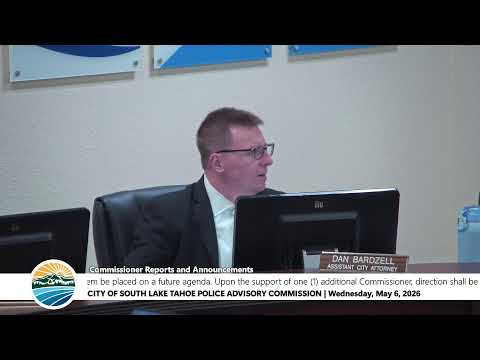
South Lake Tahoe police lieutenant outlines detentions, Miranda and limits on search warrants
Summary
Lieutenant Scott Carvelli told the commission that detentions require reasonable suspicion, arrests and search warrants require probable cause, juveniles generally cannot waive Miranda under SB 203, and that geofence warrants are facing legal challenges; commissioners pressed the department on bias training, language access and SRO policies.
Lieutenant Scott Carvelli of the police department gave a detailed, training-style briefing to the commission on how officers handle detentions, arrests, Miranda warnings and search warrants, and answered commissioners’ questions about bias training, juvenile interviews and emerging electronic-evidence tools.
Carvelli defined a detention and its legal basis, saying, “Reasonable suspicion is defined as specific articulable facts that criminal activity may be afoot,” and citing the Terry v. Ohio (1968) standard used to justify stop-and-frisk–style investigatory stops. He distinguished that level from probable cause, which he described as “facts and circumstances that would lead a reasonable person to believe a crime occurred,” and said probable cause supports arrests and search-warrant applications.
The lieutenant walked the commission through the arrest and booking process, including medical clearance for incarceration and the magistrate-review window he cited as 48 hours (excluding weekends and holidays). He noted the difference between arrest and conviction and summarized speedy-trial timeframes as conveyed in the briefing: “from arraignment…a felony, if time is not waived, should have a jury trial within 60 days; a misdemeanor, 30 days,” according to his description.
On Miranda, Carvelli emphasized that two elements must be present before warnings apply: custody and interrogation. “If you’re not in custody, it doesn’t apply,” he said. He explained the difference between implicit and express waivers, and said questioning must stop immediately when a suspect states they want an attorney.
Carvelli said juveniles are treated differently under recent state rules: “SB 203 said juveniles cannot waive their Miranda rights,” he told the commission, and added that minors generally must see counsel before custodial questioning.
The lieutenant also described the department’s interview training. “We practice…science based interviewing,” he said, characterizing the approach as more open-ended and conversational in order to reduce false confessions and improve accuracy.
On search warrants he listed common grounds for seeking one—stolen or embezzled property, evidence of a felony, child-exploitation material, firearms, controlled substances and blood for DUI investigations—and stressed the importance of specificity in affidavits. Using an example, he said a warrant to look for a stolen bicycle would not lawfully authorize a broad search of bedside drawers, but that an officer who encounters contraband in plain view may seize it and then seek a second warrant if further searching is needed.
Carvelli described common exceptions to the warrant requirement (exigent circumstances, hot pursuit, consent, plain view) and the department’s typical service window for residential search warrants—he cited 7 a.m. to 10 p.m.—and the knock-and-notice requirement. He also explained differences for probation and parole: people on supervised release may face broader search conditions, he said.
The lieutenant discussed technology and privacy, referencing California’s electronic-communications rules and the department’s practice when handling electronic devices: officers may seize devices during an investigation but generally must obtain a specific warrant to search content, and he cited CalECPA–style requirements that warrant affidavits describe a limited timeframe and scope. He described emergency cell-phone pings and delayed-notification letters after electronic searches, and raised geofence warrants as a contested tool: the department can ask a company like Google for device IDs within a defined area and time window, he said, but returns are device identifiers that require further steps to tie to an individual. “There’s a chance we lose the ability to do geofence warrants,” he added, noting ongoing litigation.
In question-and-answer, commissioners pressed on training to reduce racially disparate stops; Carvelli said officers receive POST-mandated refresher courses and field training on biased policing and that the department emphasizes articulable facts for stops. On language access, he described use of LanguageLine phone interpretation and said the department will pause important interviews if a qualified in-person or law-enforcement–trained interpreter is needed. When asked about SRO (school-resource-officer) interactions with juveniles, he said policy is typically situation-dependent and requires balancing school rules, juvenile protections and investigatory needs; parental notification is required by law but sometimes happens after other steps.
Carvelli also provided staff updates: two officers had been designated full-time marine officers, with an on-boat start date cited as May 23; a lateral candidate was due to begin May 26; and an upcoming July academy class at SACPD was expected to supply additional officers. He noted a recent fraud-prevention presentation for seniors and defensive-tactics training for CSOs.
Procedural note: the commission approved the previous meeting minutes on the consent agenda; a commissioner moved to approve the minutes, the chair seconded, and the clerk recorded the motion as carried unanimously. The meeting concluded after commissioners requested future briefings on interagency cooperation (county, Nevada, federal) and potential presentations including an FBI representative.
What’s next: commissioners scheduled follow-up items—possible agenda topics include implementation of daylighting/clear zones at intersections and a staff briefing on regional interagency roles; the commission’s next meeting was announced for 08/05/2026.
Sources and attributions: quotations and substantive descriptions in this report come from Lieutenant Scott Carvelli’s presentation and the public Q&A during the meeting, as recorded in the meeting transcript.