Get Full Government Meeting Transcripts, Videos, & Alerts Forever!
Get email alerts on the Solid Waste Rates topic
No spam. Unsubscribe anytime.
Consultants tell Merced Council rates need modest annual bumps to avoid depleting solid-waste fund
Summary
Consultants for Merced City presented two five-year solid-waste rate scenarios — roughly 4.5% or 5.3% annually — and told council the fund will be depleted in the long run without action; staff will return with Proposition 218 notice options after further direction.
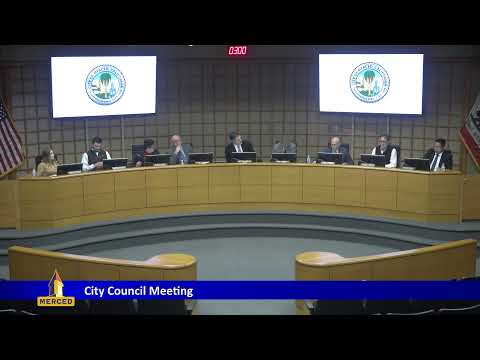
Merced City heard a detailed five-year financial review of its solid-waste operation on Jan. 20, with consultants recommending modest annual rate adjustments to keep the service solvent.
G. Schultz of R3 Consulting said the city’s current solid-waste revenues fall short of projected expenses and that “we are recommending rate adjustments somewhere between 4.5 and 5.3% corresponding to the two options that we put before you this evening.” Schultz emphasized that the study models operating- and capital-cost growth and that the fund’s reserves would be drawn down without a multi-year rate plan.
The consultants presented two options: a uniform 5.3% annual adjustment across classifications for up to five years, or a 4.5% option that staggers higher increases in later years. Staff and consultants said both scenarios use the same expense projections; the difference is timing of revenue recovery. Schultz also warned that later capital costs could be substantially higher if zero‑emission vehicle (ZEV) mandates accelerate: “collection vehicle costs are anticipated to double starting in year six,” he told the council.
Council members probed assumptions about population growth, route additions and whether the model included charging infrastructure for ZEVs. Schultz said the first five years’ projection does not assume purchases of ZEV collection trucks; it assumes a 2x factor for capital replacement costs in later years because of uncertainty about future vehicle and charging costs. Staff added that some capital debt (a corporation-yard phase-three share) is already reflected in the model.
Several council members said they preferred predictable, single-step increases over approaches that postpone costs and force larger spikes later. Councilmember Smith urged the council to avoid a later escalator that would “convey to our community that there's some kind of drastic raise in rates when really it was something that was planned,” and said he preferred a one‑time increase that better tracks cost of service.
No final rate decision or Prop. 218 notice was issued that night. Consultants urged the council to direct staff to issue the required 45‑day written notice to ratepayers only after the council picks an option or requests modification. City staff said they would schedule the required public-notice and hearing steps once the council gives direction; at the study session the council took comments but did not adopt an immediate course of action.
What happens next: staff will return with more detailed rate schedules and notice language for a future public hearing. If the council authorizes a multi-year rate schedule it must follow the Prop. 218 notice and hearing process required for property-related rates and fees.
Why it matters: solid-waste collection is a rate-funded service; without adjustments the city projects the fund balance will fall below recommended minimum reserves within the longer-term forecast. The choice between smaller near-term increases and lower short-term pain with larger future spikes will shape household bills and the city’s ability to bank funds for future capital such as ZEV trucks and charging infrastructure.