Get Full Government Meeting Transcripts, Videos, & Alerts Forever!
Get email alerts on the Electric Code Amendment topic
No spam. Unsubscribe anytime.
County official outlines proposed electric-preference building-code amendment at Town of Buena Vista work session
Summary
County building-safety staff presented a draft amendment that would add options in the energy code to incentivize all-electric new construction, adjust energy-efficiency credits, and require future-ready wiring for solar and EV charging; trustees raised affordability and grid-capacity questions and may delay a town hearing pending county action.
At a March 24, 2026 work session, county building-safety official Chad Chadwick walked the Town of Buena Vista trustees through a draft amendment intended to incentivize electric-first pathways in the town's energy code for new construction. Chadwick said the amendment is optional for builders but would adjust energy-efficiency credit pathways to make all-electric designs more attractive and require future-ready wiring for rooftop solar and electric-vehicle charging.
Chadwick said the amendment "does not outline gas in any way, shape or form" and is designed to offer compliance options rather than prohibit natural gas. He cited a 2021 builder survey and a 2022 cost study of the building-decarbonization code when describing the financial impacts: "an all-electric single family home is $3,930 to $8,200 cheaper to construct" than a mixed-fuel home, he said. County sustainability staff member Julie told trustees that, based on the same studies, an all‑electric house can draw about 34% less total energy over its life and that, with efficient heat pumps and time-of-use pricing, occupant energy costs are often lower in the long run.
Trustees and residents pressed staff on practical concerns. One trustee asked whether heat-pump systems are viable in the town's colder heating regime; Chadwick replied that modern cold‑climate heat pumps and the code's efficiency requirements aim to address that. Another trustee asked about large, high-demand users—"data centers"—and whether new electrification could push local electricity prices higher; Chadwick said the state is considering legislation to limit grid impacts of big new loads and added that local generation, rooftop and community solar, and battery backup are part of the mitigation picture.
During public comment, resident Randy Crane told trustees he had pulled federal data and his own billing information and that, in his view, heating with electricity currently costs more in many cases. "On average, it costs about 42% more to heat a home with electricity versus natural gas," he said, citing his interpretation of Department of Energy figures and a recent electric bill. Chadwick and Julie framed such numbers as dependent on equipment choice, local utility rates and grid losses, and they emphasized the amendment's focus on design choices—air sealing, heat pumps and electrification-ready wiring—that influence long-term costs.
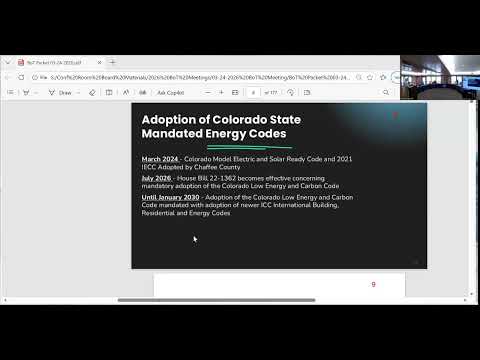
Procedurally, trustees noted the town had tentatively scheduled a public hearing for April 14 but several members said the hearing might be delayed until the county finalizes its own adoption so the town can adopt matching language. Chadwick also noted an upcoming state code—referred to in the presentation as the Colorado Low Energy and Carbon Code and tied to House Bill 22-1362—and reminded the board there are statutory timelines for state-level adoption (staff told trustees jurisdictions have until 2030 to adopt the next state code cycle).
The county staff said the amendment is still being edited and that workshops for contractors and designers are part of a broader outreach effort. If the town elects to proceed, trustees will schedule a public hearing and eventual ordinance consideration; staff emphasized adoption would apply to new construction, not retrofits, and that several compliance pathways will remain available to designers and developers.
Next steps: trustees will decide whether to retain the April 14 public hearing date or delay it until after the county finalizes its code language; staff will return with any agreed edits and with answers to outstanding questions about local cost comparisons and utility-rate impacts.