Get Full Government Meeting Transcripts, Videos, & Alerts Forever!
Get email alerts on the Mosquito Abatement topic
No spam. Unsubscribe anytime.
Saint Tammany mosquito abatement seeks 2.95‑mill renewal after detecting West Nile in traps
Summary
Dr. Kevin Kiewit told the parish council the mosquito abatement district detected a West Nile–positive pool and is asking voters to renew a 10‑year millage capped at 2.95 mills to sustain operations; staff said the proposal would keep current services and set a ten‑year funding cap.
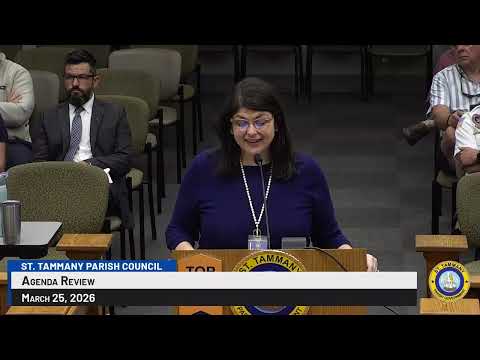
Dr. Kevin Kiewit, executive director of Saint Tammany Parish Mosquito Abatement, told the council the district detected its first pool of West Nile virus‑positive mosquitoes "just this last Monday" and asked members to support a June 27 ballot renewal that would cap the district's millage at 2.95 mills for ten years.
The request, presented during consideration of Council series 7295, asks voters to approve a renewal that officials say would sustain current services and provide a planning cap of roughly $9.3 million while the district's 2025 budget is $8.4 million. "At 2.95 mills, this maintains all of the services you're currently getting from mosquito abatement," Kiewit said. He added the millage cap is intended to provide fiscal certainty over a decade without obligating the district to levy the full amount each year.
Why it matters: Kiewit framed the proposal as a public‑health measure. He described local environmental drivers — 65 square miles of coastal marsh, bottomland swamps, the Pearl River basin, heavy clay soils and many septic systems — that create breeding habitat for the district's primary West Nile vector. He warned the parish has seen a cyclical pattern of outbreaks and cited nine human neuroinvasive West Nile cases in the parish last year as evidence of ongoing risk.
Kiewit gave specific budget context: the district's ad valorem millage was last renewed in 2016 at 4.2 mills; the board has reduced levies in recent renewals and proposed 2.95 mills now. He said the proposed rate would save taxpayers roughly $4 million annually compared with levying the full 4.2 mills and estimated the cost for a median $300,000 home at about $1.30 per week. "This will save taxpayers about $4 million a year on this renewal," Kiewit said.
Council members pressed for operational details. Mr. Kugel asked about a public bid for jet fuel used by the district’s two aircraft; Kiewit said yearly aircraft fuel costs are roughly $30,000. Mr. Phillips and others asked about revenue projections and whether the 2.95‑mill cap is adjustable; Kiewit said the district would adjust its levy annually as needed and that the 2.95 mills is a ceiling for planning purposes. Several members praised the district's stewardship while noting recent organizational challenges.
Procedural next step: Council members moved to refer Resolution 7295 for further committee consideration; the motion was seconded and advanced by voice vote.
The district's request will next proceed through the committee process before any final council action and, if approved for the ballot, would appear on the June 27 ballot for voter consideration.