Get Full Government Meeting Transcripts, Videos, & Alerts Forever!
Get email alerts on the Project Timeline topic
No spam. Unsubscribe anytime.
Medford committee shortens field of high‑school design options, approves matrix with scoring changes
Summary
The Medford Comprehensive High School Building Committee heard MSBA feedback asking it to narrow 29 design options to 3–5, approved an amended evaluation matrix, and passed votes to adjust maintenance and vertical‑circulation scoring ahead of a June 10 vote on a single preferred option.
The Medford Comprehensive High School Building Committee met remotely March 17 and moved to accelerate work on the city’s long‑range high‑school replacement project after the Massachusetts School Building Authority asked the committee to reduce its 29 design options to three to five options for more detailed study.
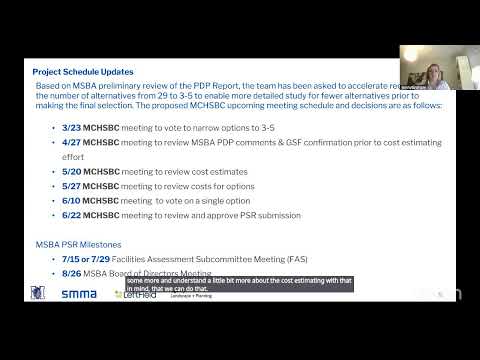
Jen Carlson of Left Field, the district’s owner’s‑representative team, told the committee the MSBA asked the project team to “narrow the options from 29 options all the way down to 3 to 5 no later than April 2” so the team can prepare the Preferred Schematic Report (PSR) pathway. She said the committee is scheduled to pick a single preferred option June 10 so the PSR can be submitted to MSBA in late June, leading to an MSBA board date tentatively set for Aug. 26.
Why it matters: narrowing the list will let estimators and designers focus on a smaller set of alternatives and produce more accurate cost and life‑cycle estimates. Project staff emphasized that the matrix being discussed is comparative — an aide to decision‑making, not a binding selection.
Committee work on the evaluation matrix dominated the meeting. The project team outlined the matrix’s 10 categories and explained color‑coded scoring (0 = unfavorable, 2 = neutral, 5 = favorable), while pointing members to an assessment‑rationale tab that explains how each criterion was judged. Matt, a member of the project team who led the matrix walkthrough, said operational cost cells remain largely blank because life‑cycle data are not yet available and will improve once the team studies fewer options.
Several formal votes amended how the matrix will be used. Committee members passed a motion to raise certain “ease of maintenance” scores (criterion 5.1) from 0 to 2 for selected options (C3.1, C3.2, D1.1 and D2.1). The roll call vote was 12–0, with three members absent. Later the committee approved a motion to treat any option taller than four stories as less favorable for navigating between classes (downgrading that criterion to a 2); that motion also passed on roll call.
The committee also debated, but did not adopt, a proposal to multiply cost criteria by 10 to prioritize price within the matrix. That motion failed for lack of a second.
Pool access and sequencing drew sustained discussion. Committee member Paul Malone warned that most options that renovate or rebuild the school would leave the existing pool unavailable to the community for an extended period. He summarized the point this way: “There are no scenarios for at all where the pool is not closed for an extensive amount of time.” Project staff replied that a renovation scenario would likely disrupt pool access for “between 12 and 18 months,” and that some options (for example a freestanding pool in certain all‑new scenarios) could allow earlier pool availability but would be treated as a separate scope and, under MSBA rules, would not receive MSBA reimbursement. Committee members discussed whether a community pool should be pursued as a separate, votable debt‑exclusion project.
Next steps: the committee agreed to distribute a non‑binding straw poll to both voting and non‑voting members so the March 23 meeting can begin with committee preferences and focus debate. The project team will post the revised matrix and updated visuals as a working draft and provide clarified diagrams before the April 27 meeting, which the team said will be dedicated to scope choices (for example, whether to include a teen health center or pool in the program) that drive gross square footage and therefore cost estimates. Cost estimates for the narrowed set of options are scheduled for May, with follow‑up review May 27 and a June 10 vote on a single preferred option for the PSR.
Actions and votes taken: the committee voted to table approval of the March minutes (motion to table passed 11–0 with four absent), approved amendments to ease‑of‑maintenance scoring (12–0, three absent), approved the vertical‑circulation scoring change for taller options (12–0, three absent), approved posting the matrix as amended (11–0 recorded), and voted to begin the next meeting with a straw‑poll summary of member preferences.
The committee adjourned after confirming the schedule and community outreach plan, including public forums and pop‑up events where residents can view options and provide input ahead of the June decision.