Get Full Government Meeting Transcripts, Videos, & Alerts Forever!
Get email alerts on the High School Rebuild topic
No spam. Unsubscribe anytime.
Medford building committee narrows high‑school options, approves community mailer amid heated pool debate
Summary
The Medford Comprehensive High School Building Committee voted to advance six finalist concepts to the MSBA for further study, approved a widely distributed community mailer, and heard hours of public comment focused largely on whether to preserve or replace the high‑school pool.
The Medford Comprehensive High School Building Committee voted to advance a set of six finalist concepts to the Massachusetts School Building Authority for further study, approved outreach mail and spent the evening debating timelines, modular classrooms and whether the school’s pool should be preserved.
Chair Jenny Graham convened the meeting and the committee first approved two sets of minutes and the month’s invoices before moving to policy and design items. The board voted unanimously to approve minutes from the Feb. 25 and March 17 meetings and to pay three project invoices (Left Field, SMA and environmental/site work) as presented by the project team.
After the routine business the committee considered a proposal to send a citywide informational postcard to roughly 26,000 households using EDDM mailings. The project team presented vendor estimates ranging “about $8,000 to about $15,000,” and members debated whether the mailer should provide only awareness, invite participation, or include links to a tax calculator showing possible household impacts. The committee authorized the mailer and directed the project team to circulate a draft for committee review; that motion passed unanimously.
The meeting’s substantive focus shifted to the multi‑year planning process for a new or renovated Medford High School. Project consultants summarized community engagement to date — staff and community workshops, voice‑and‑vision cards, pom‑pom jars and heat‑map dot boards — and explained the straw‑poll and scoring used to sort 29 initial alternatives into a manageable set. Consultants noted recurring priorities from the public and staff: preserving community assets (pool, gym, vocational shops), minimizing traffic impacts, and designing flexible academic and CTE spaces.
The pool emerged as the most sustained public theme. Dozens of residents and several swim‑program leaders urged the committee to keep a pool on the campus for regional swim lessons, team use and water‑safety instruction. Speakers described the pool as a public safety and equity resource; others cautioned about the operational cost to Medford Public Schools, urging clearer financial information. Project staff clarified MSBA reimbursement rules: a pool included as part of a renovation option may be presented inside the school project but reimbursement treatment differs from a new, freestanding pool. Consultants said a new pool that is procured as a separate project would be funded through its own debt‑exclusion process and would not be MSBA‑reimbursed.
Committee deliberations centered on four tradeoffs: minimizing student disruption (number of temporary modular classrooms required for each option), phasing and schedule length, whether to retain and renovate portions of the existing building (to capture MSBA incentives for reuse), and site placement (building on the parking lot vs. on the field/Edgely area). Several board members described the number of required modular classrooms — in some options more than 70–90 units — as a major factor that would increase cost and extend the construction schedule.
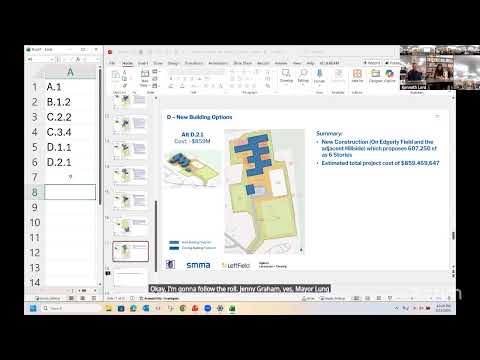
After extended discussion and multiple roll‑call votes to remove lesser‑favored concepts, the building committee voted to send these finalists to the MSBA: the code‑upgrade “A” option (to remain on the table), renovation variant B1.2, C2.2, C3.4, D1.1 and D2.1. The final motion to forward the package passed on the recorded vote in the transcript (13 in the affirmative as recorded). The project team will return to the committee with more detailed cost and reimbursement analysis in May; the team said that additional analysis should clarify MSBA reimbursement rates, phasing consequences and the likely debt‑exclusion impacts for non‑reimbursable items such as a new pool.
What’s next: the committee asked the project team to refine cost estimates and return draft mailer language for public review before the April 27 meeting. The MSBA will review the finalists; the project team said it would use the narrower set to request deeper MSBA guidance on reimburseable scope and detailed cost comparisons.
Quotes: Committee members and speakers often emphasized competing priorities. “We can do a draft for review and approval,” the chair said about the mailer. Project staff summarized technical constraints: “If a pool is new construction it needs to be its own separate project” and “a renovated pool will likely be out of service 12–18 months.” Public commenters urged retention of the pool: “It’s a life‑safety issue for the whole region,” one resident said. Another speaker asked the committee to “preserve the parts of the building that we can” to reduce cost and maintain community spaces.
The meeting adjourned after the group confirmed the six finalists and asked the project team to return with more refined cost and reimbursement analysis.