Get Full Government Meeting Transcripts, Videos, & Alerts Forever!
Get email alerts on the Compensation topic
No spam. Unsubscribe anytime.
Consultants urge phased pay updates after study finds Navasota salaries well below market
Summary
A compensation study presented March 23 found broad pay gaps—police and fire among the largest—and recommended a two-step implementation (partial in April, additional 5% in October) with estimated partial-year costs of about $232,000 (≈8% of payroll).
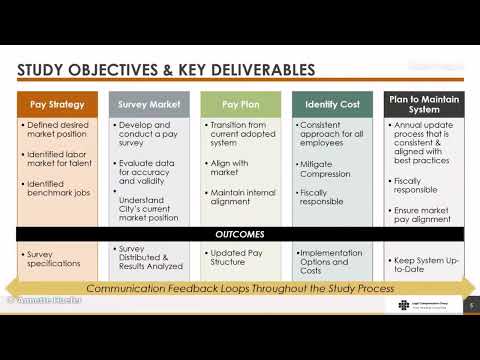
Annette Hayer, principal consultant with Logic Compensation Group, told the Navasota City Council that the firm’s market survey shows the city’s pay ranges are misaligned with comparator cities and recommended structural changes to bring salaries closer to market. "My name is Annette Hayer and I'm a principal consultant with the Logic Compensation Group," she said when introducing the study and its methods.
The study compared 43 benchmark jobs to a median of 20 comparator organizations and used a January 1, 2026 effective date for market data. Hayer said the thresholds for alignment treat pay within ±5% of the market as highly aligned, 10–15% as misaligned, and differences greater than 15% as significantly misaligned. The study found citywide gaps: general job minimums were about 20.1% below market and maximums about 26.4% below, while police minimums were 33.4% below market and fire minimums 19% below. Across all jobs, Navasota’s actual overall salaries were roughly 18.8% below the market median.
City staff described a two-step implementation to soften budget impact. Robert, staff lead on the study rollout, summarized the plan: a first-phase implementation in April to slot employees into the updated structure and a second step of an across-the-board 5% adjustment proposed for the October 1 fiscal changeover. "We decided to take a first step in April, get the structure implemented, get every employee onto one of the steps in the pre-defined step plan," Robert said. The partial-year cost estimate for April–October is approximately $232,000, or about 8% of total payroll; that figure excludes benefits and overtime.
Council members pressed for details about who would receive the largest raises and how the plan would affect the budget and services. Some members and a public commenter, Dia Copeland, asked that the council review three-to-five years of turnover data and exit-survey findings before making sweeping changes. "I would like to see ... we would not change item number five, the purchasing policies, until all of the audit issues are corrected," Copeland said during visitor remarks, and she also requested access to turnover statistics and exit surveys to determine whether departures were due to pay, relocation, termination or leadership.
Hayer and staff said implementation decisions would aim to prioritize positions farthest below market—public safety and public works were cited as examples—and to limit compression (subordinates earning close to or more than supervisors) by maintaining grade separations and step progression rules. The consultants recommended annual monitoring and a comprehensive salary survey every three to four years to prevent recurring large gaps.
The council did not vote on implementation at the workshop; staff said they will incorporate the April action into current budget planning and return to the council with specific budget numbers and placement details during upcoming budget workshops.