Get Full Government Meeting Transcripts, Videos, & Alerts Forever!
Get email alerts on the Facilities And Capital topic
No spam. Unsubscribe anytime.
Minnesota State tells trustees the system faces a $1.8 billion facilities renewal backlog and asks whether demolition should be funded
Summary
System staff told trustees the Minnesota State facilities portfolio faces an estimated $1.8 billion deferred renewal backlog and declining campus utilization driven by online and dual-enrollment growth; options presented include demolition, increased renewal funding, stacked finances and exploring borrowing authority.
System office officials told the Academic and Student Affairs Committee that Minnesota State's campus buildings are aging and underfunded, creating a growing deferred-renewal backlog they estimated at roughly $1.8 billion.
"This deferred renewal challenge is the result of two converging factors: facility age and underinvestment," a system facilities lead said in the committee briefing.
The presentation described three drivers of the problem: declining in-person classroom utilization as delivery shifts online and into high-school concurrent enrollment; a majority of buildings crossing the 50-year useful-life threshold; and a sustained decline in state capital funding and campus reinvestment. System staff said only about 60% of space is reliably coded in existing records and that campus-level space-management tools are inadequate for planning.
Among the responses presented to trustees were incremental and systemic approaches: a request to the legislature for $25 million to demolish roughly 500,000 gross square feet of obsolete space (the system identified 1.3 million gross square feet systemwide as candidates for removal); raising campus repair-and-replacement contributions; using pooled system reserves for targeted short-term capital; adopting enterprise space-management tools and hiring planning staff; and seeking new borrowing authority to finance larger projects. Officials said demolition reduces operating and renewal costs but requires an upfront capital outlay and that savings are realized over time at the campus level.
Brian Swanson, associate vice chancellor for facilities, told trustees the costs of keeping empty buildings are recurring and meaningful: "You can continue to carry underutilized facilities, but it's a lot of work and it's a lot more expensive." He cited national benchmarks showing a sector-wide shortfall in renewal funding and warned that Minnesota State's deferred backlog could grow as older condition assessments are updated.
Trustees emphasized that decisions about the physical footprint must be balanced with academic priorities and equity goals, and asked for concrete "if/then" scenarios showing how reallocated funds would affect specific campuses. Several trustees suggested more aggressive approaches — including demolition and shared-use partnerships with local governments — and urged that any reallocation include adequate time for campuses to adapt their budgets.
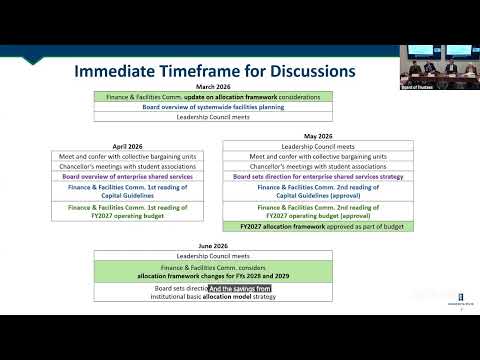
System staff said they will bring specific proposals and modeled scenarios to upcoming leadership-council meetings and to the board in April–June, and that major allocation-model changes would require a longer, more consultative study over an academic year.
"The only real measure of utilization historically has been classroom and laboratory schedules. The shift to high flex and online modalities has radically changed how campuses are used," Swanson said. Trustees requested analyses that link space, modality, and student outcomes so the board can weigh facility decisions against academic trade-offs.
No formal board action was taken; staff will return with modeled scenarios for possible reallocation and a timetable for any proposal that would change the allocation framework.