Get Full Government Meeting Transcripts, Videos, & Alerts Forever!
Get email alerts on the Enrollment And Budget topic
No spam. Unsubscribe anytime.
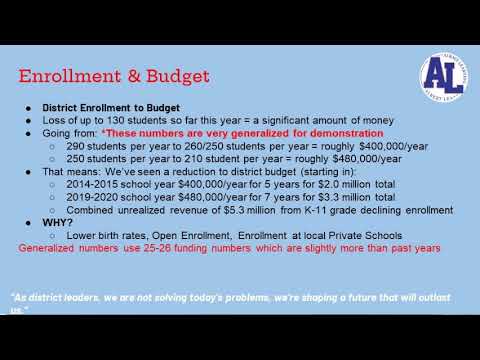
Albert Lea district warns of sustained enrollment declines, outlines $2.6 million in planned cuts
Summary
Superintendent Dr. Hy told the school board that multi-year student declines are shrinking class cohorts and reducing revenue; the district projects multi-year unrealized revenue and has approved $2.6 million in cuts this year while planning further reductions and community outreach.
Superintendent Dr. Hy told the Albert Lea Public School District board on March 16 that the district is experiencing a sustained, multi-year drop in student enrollment and that the shortfall is forcing staff reductions and budget cuts.
"We were down 130 students this year," Dr. Hy said while presenting weekly and year-to-date enrollment reports, noting separate counts for the alternative learning center (ALC) and a kindergarten cohort of 193. Using a generalized per-student figure of about $12,000, the superintendent illustrated how shifting cohort sizes have reduced the district's revenue over multiple years and said the district has about $2–3 million in cumulative ‘‘unrealized revenue’’ across recent years.
The superintendent described how cohorts created a ‘‘bubble’’ of larger classes in some grades and smaller ones in others, and said the district is transitioning into more—but smaller—cohorts, which drives the need to right-size staffing and operations. "This is going to be hard. It's not fun to do," Dr. Hy said, adding that the district cannot operate indefinitely on reserves.
Board members and staff reviewed fund-balance policy and recent uses of one-time federal ESSER (COVID-era) funds, which were used to keep personnel in place and therefore created recurring cost pressures when the funds expired. Board discussion cited prior local practice of maintaining roughly a 12% reserve to manage state payment timing and shocks. Several members noted that dipping into reserves would compound budgetary shortfalls in subsequent years.
District staff said this year's planned cuts total about $2.6 million; earlier reductions included a reported $1.3 million in 2023–24 and $2 million the previous year. The superintendent stressed these figures are compiled from multiple sources and are intended as high-level estimates, not precise single-year forecasts.
On staffing, the superintendent described processes for tiered staff (tier 2/3/4 and optional-filed personnel): job-posting windows, recall in inverse order, and statutory timelines that constrain when offers can be made. He said the district will move some out-of-classroom staff back into classrooms where feasible, reduce FTEs in low-enrollment buildings, expand the district's online program capacity to regain students on waiting lists, and hold community and parent meetings as task-force recommendations are finalized.
The board did not take additional budget votes beyond approving routine items at the meeting. Several members urged advocacy at the state level, including attention to permanent-state-fund payout policy and compensatory-funding shortfalls that affect districts statewide.
Next steps: the superintendent said the board will review further proposed cuts at the April meeting and consider a district task force's recommendations before finalizing long-term staffing and budget plans.