Get Full Government Meeting Transcripts, Videos, & Alerts Forever!
Get email alerts on the Whittier Narrows Dam topic
No spam. Unsubscribe anytime.
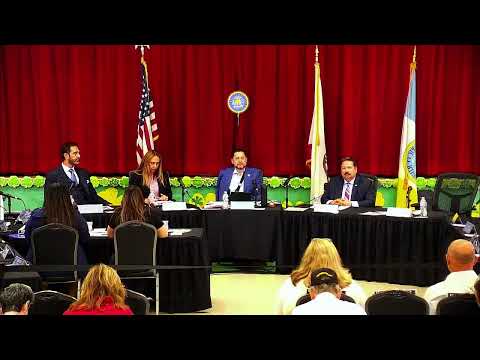
Army Corps outlines Whittier Narrows Dam repairs, warns of multi-year construction and park impacts in Pico Rivera
Summary
The U.S. Army Corps of Engineers told Pico Rivera council members the Whittier Narrows Dam safety project is funded and a contractor has been chosen; the repairs will require multi-year construction that will close and alter Corps-leased parkland, change road profiles and prompt town halls and outreach.
Aaron Smith, a project representative with the U.S. Army Corps of Engineers, told the Pico Rivera City Council that the Whittier Narrows Dam safety improvement project has secured funding and a construction contract and that major work will begin as soon as the Corps and contractor finalize schedules.
Smith said a contractor selection (Barnard Construction) has been made and that crews could be on site “as early as October,” though in other parts of the presentation he and council members discussed a start and active work window beginning in 2026 with multi-year construction through the early 2030s. He described the work as focused on two failure modes: seepage through the dam’s sandy foundation and overtopping during extremely rare storms. “There is no imminent risk to Pico Rivera,” Smith said, while adding that the consequences of a dam failure would be severe and that the Corps wants to reduce that long-term risk.
Why the work is needed: Smith explained that the sand foundation beneath the earthen dam is vulnerable to erosion if water seeps beneath the structure; engineers plan to cut an interception trench on the downstream (Pico Rivera) side to relieve pressure and extend a low berm to add weight. To address potential overtopping, the Corps will place engineered concrete “steps” or armoring on the dam’s downstream face to dissipate flow energy.
Construction scope and community impacts: Much of the work, Smith said, must take place on the Pico Rivera side of the dam because of the subsurface conditions identified by modern forecasting and analysis. The contractor requires large staging areas for materials, batching and equipment; the Corps identified a primary staging area near Durfee and Rosemead (referred to colloquially as “Strawberry Fields”).
Several permanent and semi-permanent impacts were described: Rosemead Boulevard and Lincoln Avenue will be raised about 6 feet where they cross the dam, a portion of Workman Road (near the 605) will be permanently closed, and portions of Streamland Park and the Pico Rivera Golf Course will be used as contractor staging and may be modified by the new berm. The Corps said it will work to restore or re‑outgrant affected facilities when work is complete, but the post‑construction recreational layout could differ from today and some uses (for example, ball fields) may not be compatible with the reconstructed dam footprint.
Traffic, trails and safety: Smith warned of heavy construction traffic crossing Rosemead and Lincoln, periodic night work for critical concrete placements and closures of trails and pedestrian crossings across the dam during active construction. The site will be secured 24/7 with guards; contractors will follow local ordinances for noise, dust and vibration.
Council questions and mitigation: Council members pressed the Corps on sequencing, resident protections, lighting and partnerships to fund “betterments” such as additional lighting on Rosemead. The Corps said contractors are constrained by sequencing and emergency-action plans so that excavation will not make the dam more vulnerable during storms, and that contractors will collect baseline vibration/noise data and perform pre-construction condition surveys so residents can document impacts.
Schedule uncertainty: The meeting record includes differing scheduling statements: Smith said work could begin “as early as October” and at other points referred to a late‑2026 start; council members later summarized a project timeline running roughly 2026–2033. The Corps committed to town halls (an April 16 town hall was announced) and neighborhood canvassing to collect community concerns ahead of major work.
Next steps: The Corps set up a project website, a dedicated project email and promised continuing public events and canvassing. Council members said they will continue coordinating with federal and county partners to pursue mitigation options and funding for local improvements that the Corps cannot fund directly.
Ending: The Corps’ presentation closed with a commitment to continued engagement and to minimizing impacts where possible; council members asked staff to work with residents and federal representatives to find mitigation funding and temporary recreational alternatives while work proceeds.