Get Full Government Meeting Transcripts, Videos, & Alerts Forever!
Get email alerts on the Food Rescue Donation topic
No spam. Unsubscribe anytime.
MassDEP gathers food‑rescue groups to map grants, gaps and next steps for donation expansion
Summary
MassDEP convened an Organics Subcommittee webinar where officials and food‑rescue organizations discussed grant timelines, cold‑chain and storage gaps, legal concerns and coordination tools as the agency plans a revised Organics Action Plan and considers lowering the food‑waste disposal threshold.
BOSTON — The Massachusetts Department of Environmental Protection hosted an Organics Subcommittee webinar that brought MassDEP staff together with food‑rescue organizations from across the state to review grant opportunities, identify infrastructure gaps and solicit stakeholder input on how to scale food donation and rescue.
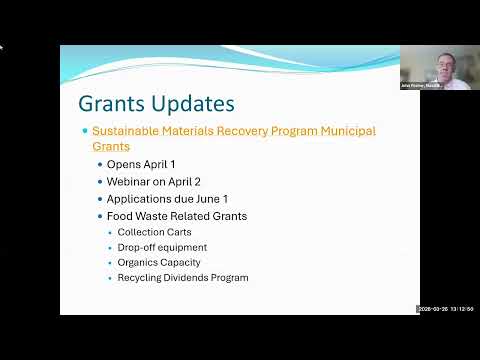
John Fischer, MassDEP’s deputy division director for solid waste, opened the meeting by announcing three grant offerings and a yearlong stakeholder process to revise the agency’s Organics Action Plan. “We are going to be recording the meeting here this afternoon,” Fischer said, describing plans to post slides and the recording on MassDEP’s organic subcommittee webpage and to hold “6 to 8” focused meetings over the coming months.
Why it matters: MassDEP is weighing changes to its Solid Waste Master Plan and potential adjustments to the state’s food‑waste disposal ban, which currently applies to businesses and institutions that dispose of a half‑ton or more of food material per week. Fischer said the agency has circulated a potential proposal for an expanded ban but will take more time to address concerns raised in prior 2025 meetings before making formal changes.
Panelists from three established food‑rescue organizations described operational realities and recurring barriers. Tim Cavaretta, senior director of operations at Food For Free, said logistics are the top constraint: “I’d say at the top would be cold chain infrastructure, so refrigerated vehicles, warehouse, you know, walk‑in coolers,” he said, and he added that matching varied donations to appropriate recipients is labor intensive. Food For Free reported nearly 1.9 million pounds of recovered food in its most recent fiscal year from 45 donor locations and 68 partner distribution sites.
Andrea Scarpellini, food access coordinator with Cape Cod Cooperative Extension, said Cape Cod’s geography and volunteer patterns complicate collections: “The Cape is 65 miles long,” she said, and long travel times, bridge congestion and dispersed volunteers make routing and pickups difficult. Scarpellini described a Sustainable Materials Recovery Program grant that funded a part‑time food‑rescue manager and a web portal to help match donors, volunteers and recipient agencies.
Jodi Falk, executive director of Rachel’s Table of Western Mass, outlined a mix of programs — rescue/recovery, purchase programs, gleaning and community gardens — and said her organization distributed almost 1 million pounds of food in 2025 with about 500 volunteers and 178 partner recipients. She emphasized persistent challenges: capacity, matching donors to agencies, transportation, storage and legal concerns that still make some potential donors reluctant to participate.
Common themes and potential remedies included building refrigerated storage and transport capacity, creating or expanding sorting and hub spaces, investing in real‑time matching databases and coordination platforms, and expanded education and outreach for small donors (restaurants, schools and individuals). Jay Levine, Rachel’s Table operations manager, described an operational model that combines regular fixed routes, daily rosters and a dispatcher who calls agencies about available donations to shorten the turnaround time between donation and distribution.
On legal and incentive questions, attendees flagged federal charitable giving tax deductions and liability protections; RecyclingWorks in Massachusetts and the Harvard Food Law and Policy Clinic have linked resources and fact sheets that MassDEP posted to the chat. Participants also noted pending state legislative proposals and a line in the Governor’s supplemental budget addressing food donation tax credits for farmers and producers.
The meeting closed with next steps from MassDEP: continued subcommittee meetings to help shape a revised Organics Action Plan, posting the recording and slides, and inviting side meetings and follow‑up conversations. Fischer emphasized stakeholder input: “I’ll basically talk to anyone, anytime, about this work, within reason,” he said.
What’s next: MassDEP will post materials from the session and continue a series of focused discussions in 2026 to refine recommendations for prevention, donation, composting interfaces and possible changes to the disposal threshold.