Get Full Government Meeting Transcripts, Videos, & Alerts Forever!
Get email alerts on the Apam Operating Regimens topic
No spam. Unsubscribe anytime.
MassDEP solicits practitioner input on operating regimens for vapor‑intrusion mitigation systems
Summary
Massachusetts Department of Environmental Protection staff held extended office hours to gather feedback on draft guidance for operating regimens that govern active pathway mitigation systems (APAMs) used to control vapor intrusion. Key practitioner concerns included telemetry design, subslab probes, monitoring frequency, cost burdens for immediate response actions, and periodic professional re‑inspection.
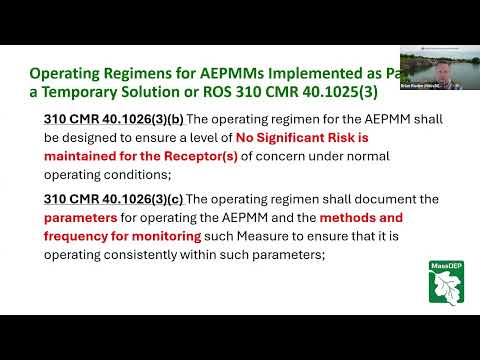
The Massachusetts Department of Environmental Protection convened an extended office‑hours session to gather technical input as it drafts guidance for operating regimens that govern active pathway mitigation measures (APAMs) — primarily systems addressing vapor intrusion — under the Massachusetts Contingency Plan. Millie Garcia Serrano, assistant commissioner for the Bureau of Waste Site Cleanup, said the guidance is intended to ensure APAMs maintain a level of No Significant Risk (NSR) over the foreseeable future.
Brian Rhoden, acting division director for the policy and planning division, reminded attendees that MassDEP sent APAM annual certification letters on March 12 to 85 permanent solutions and asked owners to return a two‑page form documenting a shutdown/restart test intended to verify telemetry. “The telemetry was installed by whoever was the previous owner; we’re not in control of that,” Rhoden said, urging property owners to take responsibility for telemetry access and contact information.
Practitioners, many of them Licensed Site Professionals (LSPs), raised technical and implementation issues that MassDEP staff said they will consider in the draft guidance. Common themes: defining what minimum vacuum or pressure‑field extension constitutes protectiveness; where and how often to measure subslab pressure; whether telemetry alone is sufficient evidence of ongoing protectiveness; and the burden and cost tradeoffs for sites that enter Immediate Response Action (IRA) mode.
Several participants argued for a sliding scale of requirements tied to system complexity. Isaac and others suggested simple single‑family installations might only need an annual cross‑slab pressure check, while multifamily or manifolded systems should include flow measurements, multiple monometers, filter maintenance schedules and more frequent checks. Andy recommended periodic subslab pressure measurements at representative points to guard against loss of the vacuum field.
A strong thread running through comments favored improved telemetry and clearer alarm design. Matt Hatman, who identified himself as an LSP, said continuous vacuum monitoring would help verify older systems and allow off‑site consultants to confirm performance without repeated site visits. Several speakers warned that poorly tuned alerts can cause notification fatigue: “If you continually get notifications, you get 100 notifications a day, you kind of tend to ignore them,” Rhoden acknowledged.
Participants disagreed on the role of routine indoor‑air sampling. Some argued that if a pressure field across the affected soil gas area is demonstrated and maintained, indoor air resampling is rarely needed; others said selective or periodic indoor sampling is prudent in high‑risk settings or where preferential pathways or building HVAC changes exist. Rachel and others cited other states (Michigan, New Jersey) that require periodic negative‑pressure verification and maintain subslab monitoring points.
Multiple attendees and several staff noted practical compliance gaps observed in MassDEP inspections. John Fitzgerald said inspections of 15 sites turned up six sites with no documented operating regimen despite AULs and LSP submittals, and six more with deficient regimens, reinforcing staff emphasis on clear documentation of system components, monitoring points, monometer locations, and a simple checklist owners can follow.
To improve long‑term stewardship, several practitioners proposed periodic professional re‑inspection (for example, every five years) by an LSP or licensed environmental professional to confirm that building changes have not undermined protectiveness. MassDEP staff said they are considering templates, owner fact sheets to include with the annual certification letters, and other outreach to encourage owner engagement and reduce transitions‑of‑ownership gaps.
MassDEP said it will incorporate feedback into a draft operating‑regimen guidance document and circulate it for public comment; staff also announced an advisory committee meeting (hybrid) scheduled for May 21 at 100 Cambridge Street in Boston. The agency asked participants to send further comments to staff contacts listed in the annual certification materials.
The meeting closed with MassDEP thanking participants and reiterating that the draft guidance will be shaped by the technical input collected during office hours and subsequent written comments.