Get Full Government Meeting Transcripts, Videos, & Alerts Forever!
Get email alerts on the Usps Finances topic
No spam. Unsubscribe anytime.
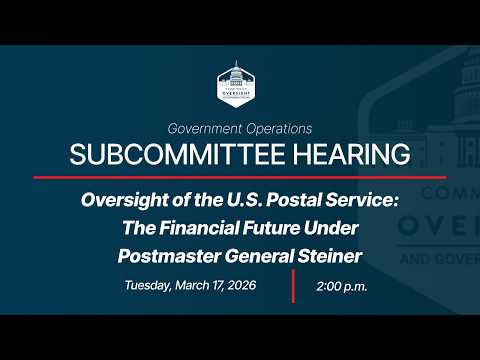
House subcommittee warned USPS faces a cash crisis within a year; Postmaster General urges greater borrowing authority
Summary
At a House Oversight subcommittee hearing, Postmaster General Steiner said the Postal Service could be out of cash within 12 months and urged Congress to increase its Treasury borrowing authority; the GAO said urgent action is needed to address structural deficits and declining mail volumes.
Postmaster General Steiner told the House Committee on Oversight and Accountability that at the Postal Service's current rate of losses it could run out of cash in less than 12 months, pressing Congress to act to avoid service disruptions.
The testimony came during a subcommittee hearing where the Government Accountability Office's David Maroney described USPS finances as a —high-risk— issue that will require difficult choices. Steiner and Maroney both told lawmakers that declines in letter mail volume, statutory limits on borrowing and other structural constraints have driven the agency toward a near-term liquidity crisis.
Steiner outlined the scale of the change in mail volume, saying the Postal Service's peak of roughly 213 billion pieces annually had fallen to about 109 billion pieces. He argued those lost pieces represent forgone revenue and pointed to several legal and regulatory constraints that limit the Service's options, including a $15 billion statutory borrowing cap established decades ago and restrictions on how the agency may invest certain retirement assets. "At our current rate, we'll be out of cash in less than 12 months," Steiner said in his opening remarks.
GAO's Maroney told the subcommittee that, based on long-term trends, USPS will struggle to reach financial sustainability without both internal reforms and congressional action. He advised Congress to decide the level of postal service the nation requires and how those services should be funded.
Members pressed for concrete proposals and data. Several lawmakers asked for a breakdown of revenues and costs by product line so they could compare where dollars are earned and where they are spent. Committee leaders and the Postmaster General agreed to provide five-year financial projections that model different combinations of mandates, price changes and cost reductions so members can evaluate legislative options.
Steiner emphasized a mix of options he said the Postal Service is pursuing, including network changes, shifting more positions to non-career staffing where allowed, reducing overtime and modest postage increases. He said raising the first-class stamp from $0.78 to between $0.90 and $0.95 would significantly reduce controllable losses while remaining low relative to many other industrialized countries.
The subcommittee did not take final votes on legislation. Members were invited to submit written questions and materials for the hearing record, and the committee recessed for floor votes. Steiner committed to follow up with the requested revenue and projection materials.
What happens next: Committee leaders said they would use the requested five-year projections and other data to evaluate whether to seek statutory changes, including an increase to the Treasury borrowing cap or other structural reforms. The Postmaster General agreed to provide the projections and additional requested detail to the subcommittee.