Get Full Government Meeting Transcripts, Videos, & Alerts Forever!
Get email alerts on the Domestic Investigation Reports topic
No spam. Unsubscribe anytime.
Douglas County court services outlines domestic investigation reports, staffing and possible program expansion
Summary
Court services staff told county commissioners the program provides judges neutral, court-ordered summaries in child custody cases, has produced 29 reports since 2024, and is exploring expansion (mediation, parenting classes) if funding and staffing allow.
Court services officers told the Douglas County Board of Commissioners on March 25 that the county's domestic investigation reports program provides judges neutral, court-ordered summaries of family circumstances in parenting-time and child custody cases.
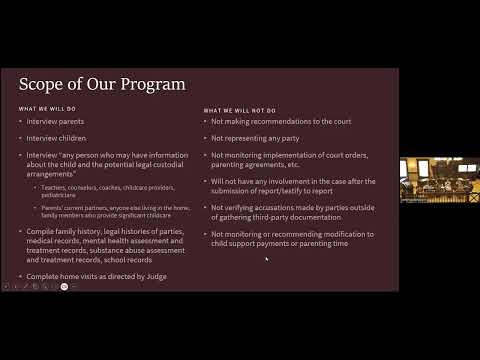
Jordan, a court services officer, said the reports are initiated only by court order and are intended to "present each party's viewpoint to the court" rather than to advocate or make recommendations, which is the role of a guardian ad litem. Jordan said the office completed child-specific interviewing training in September 2025 to improve how officers interview children when judges permit those interviews.
The program began after the court identified a gap in access to justice for indigent parents who cannot afford a guardian ad litem, Jordan said. She said she began writing domestic reports in January 2025; the office has completed 29 reports (including multiple reports in some cases) and has nine pending. Training-related costs since the program began were described as roughly $1,000, with occasional travel and rare overnight expenses tied to specific investigations.
Jordan described the evidence the unit compiles: parent interviews, collateral interviews (teachers, therapists, child-care providers), school and DCF records, protection orders and treatment records. Home visits are done when judges order them or when safety concerns arise; officers check basic safety indicators such as electricity, running water, beds and obvious hazards.
The officers said Douglas County modeled the program on similar units in other Kansas counties and cited Office of Judicial Administration data that nine Kansas counties offer a domestic court services function. Unlike many of those counties, Jordan said Douglas County does not charge parties for services. By contrast, she cited example fees from other counties: co-parenting classes $10; mediation $75; parenting coordination $200; and home-study/domestic reports $750, noting judges can waive or reduce costs.
The office's procedure begins with a judge's order; parents sign releases of information to allow record requests, and officers review incoming records while conducting interviews. Jordan said the primary delay is waiting for external records from hospitals or agencies; the typical timeline from order to report submission is about two to three months.
Commissioners asked about program outcomes and performance measures. Commissioner Anderson and others noted courts typically focus on producing enforceable orders (parenting time, financial obligations) and that measuring family-level outcomes is complicated by variations in family situations. Commissioners pressed on conflicts of interest: Jordan said the team separates supervision and report-writing duties so an officer who supervised a probation client would not write that person's domestic report.
On governance and budgeting, Jordan said the court services officers are state employees who report to the court administrator and chief judge and coordinate with the Office of Judicial Administration; county-funded staff and resources appear in the district court budget but operate under court administration.
The presenters described potential future services the program might offer if staffing and funding increase, including mediation, parenting coordination, supervised visitation and classes on parenting or basic skills for families, but said those programs are not currently available.
The work session concluded with commissioners expressing interest in tracking outcomes and exploring how other counties measure program effectiveness; no formal action or vote occurred during the informational session.