Get Full Government Meeting Transcripts, Videos, & Alerts Forever!
Get email alerts on the Land Use Rezoning topic
No spam. Unsubscribe anytime.
Planning board recommends approval of Cooper Property rezoning with affordable‑housing commitments
Summary
The Town of Pittsboro Planning Board recommended approval of rezoning case PB25345 for the 74.48‑acre Cooper Property, accepting applicant conditions including up to 300 dwelling units, a $1 million payment to Chattam Habitat for Humanity, and a 5% Hometown Heroes set‑aside; the recommendation passed 5–2.
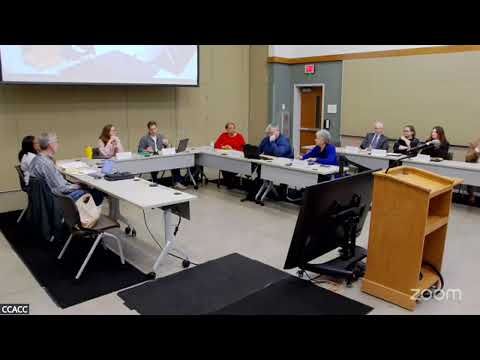
The Town of Pittsboro Planning Board on March 16 recommended approval of rezoning case PB25345, the Cooper Property, after a presentation from planning staff and the applicant team and a public question period.
Planning staff said the roughly 74.48‑acre site is currently zoned Residential Agriculture and is classified in the town’s land‑use map as Traditional Neighborhood Infill. Staff recommended rezoning the parcel to MR (Multifamily Residential) conditional zoning, saying the change is consistent with the future‑land‑use designation and the staff report’s conditions. “Planning staff recommends approval of rezoning case PB25345 for Cooper property with the conditions offered by the applicant,” Lauren (planning staff) told the board.
Representatives for the applicant, including Adam Ashbawa of DRB Group and engineering lead Landon, described a plan that would allow up to 300 residential units made up of a mix of rear‑loaded townhomes, rear‑loaded single‑family and front‑loaded single‑family product types. The applicant said the proposal includes multiple access points, internal street standards to match nearby streets, more than the minimum required common open space, a private linear park with a 10‑foot multi‑use path and a proposed extension of Old Rock Springs Cemetery Road to connect the development to the existing street network.
Adam Ashbawa said the project team heard neighborhood traffic and stormwater concerns during outreach and added conditions in response: “Our main entrance will be off of Old Rock Springs Cemetery Road and we’ll have kind of entry monumentation there,” he said, and the team volunteered to increase the minimum perimeter buffer adjacent to the cemetery/park from 20 to 30 feet. The applicant also committed to retain a 25‑year storm event on‑site and to construct two public street connections prior to the 100th certificate of occupancy, per town standards.
On affordability, the applicant offered a $1 million payment to Chattam Habitat for Humanity and a pledge that a minimum of 5% of units will be made available under a Hometown Heroes financing program (applicant representatives said the program targets public‑service employees and similar buyers). The applicant’s representative described the $1 million as being earmarked for a specific Habitat project currently in design and permitting.
Neighbors from the adjacent Powell Place subdivision raised questions about the primary entrance and whether construction traffic could be limited to the Old Rock Springs Cemetery Road connection. Board members discussed enforceability of any condition aimed at directing construction traffic and asked staff to research options; the board also asked staff to pursue further work to limit construction traffic traveling south‑to‑north on Hillsboro if feasible.
Charity moved to recommend approval of PB25345 with the additional condition to include municipal workers in the Hometown Heroes eligibility; Freda seconded. Christina and Connie voted against the motion; the motion carried 5–2, forwarding the recommendation to the Board of Commissioners.
Next steps: the Planning Board’s recommendation will go to the Board of Commissioners for final action; staff said the timing of on‑site construction depends on sewer availability and permitting but estimated design/permitting could take 9–12 months with construction starting as soon as sewer capacity is ready (the applicant estimated late 2027 as a plausible earliest start).