Get Full Government Meeting Transcripts, Videos, & Alerts Forever!
Get email alerts on the Technology Update topic
No spam. Unsubscribe anytime.
District technology team details cybersecurity, Wi-Fi upgrades and device support
Summary
Marshall Public School District IT leaders told the board they have strengthened cybersecurity defences, deployed new Wi‑Fi infrastructure and maintain a fleet of more than 3,000 devices; staff described daily support, app‑vetting and emergency communications systems.
The Marshall Public School District’s technology team gave the board an overview of cybersecurity improvements, network upgrades and daily device support during a scheduled presentation.
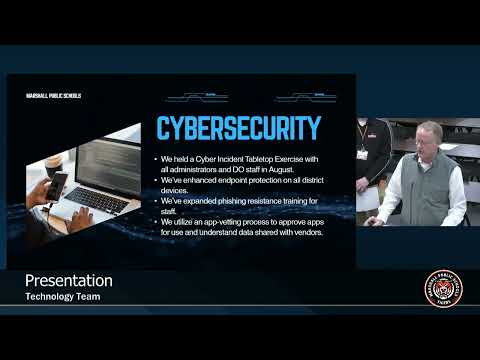
Todd Pickthornne, the district technology coordinator, told the board the district has “fortified our defenses in four crucial areas,” citing an August cyber‑incident tabletop exercise, expanded endpoint protection and broader staff phishing‑resistance training. “Success with technology is 80% people and 20% technology,” Pickthornne said, framing the update around training and operational procedures.
Pickthornne said the district completed behind‑the‑scenes switching upgrades in the 2023–24 school year and deployed Wi‑Fi 7 access points in high‑density areas such as gyms and cafeterias. He reported the network typically supports about 3,300 simultaneous wireless clients across roughly 260 access points.
Kent Powell, one of the district IT specialists, described day‑to‑day operations that keep classrooms running: troubleshooting classroom audio and display systems, issuing and repairing student devices, and maintaining safety systems such as cameras and door‑lock schedules. “In total, we manage a fleet of well over 3,000 devices,” Powell said, and explained the district follows a self‑insurance and in‑house repair approach to extend device life and reduce replacement costs.
IT specialist Nick Gping summarized digital‑signage use for announcements and emergency alerts, account automation tied to the student information system to provision and remove access, and routine server maintenance scheduled outside instructional hours to reduce disruptions. He said the district builds and maintains the digital‑signage system internally to avoid outside licensing costs.
Board members asked about service levels on e‑learning days and the volume of help‑desk calls; IT staff said calls typically rise on those days and the district operates a help‑desk hotline. Staff also described a recent vendor‑assisted update to the card‑access system needed after an expired certificate prevented normal operation.
There was no formal board action tied to the presentation. The presentation concluded with an invitation to ask follow‑up questions and to repeat cyber‑incident tabletop exercises in the future.