Get Full Government Meeting Transcripts, Videos, & Alerts Forever!
Get email alerts on the Parking topic
No spam. Unsubscribe anytime.
Delray Beach delays decision on Subculture Coffee parking requirements after large public turnout
Summary
After hours of testimony from neighbors, patrons and the business owner, the Delray Beach City Commission voted 5–0 to postpone a re‑evaluation of Subculture Coffee’s parking requirements for 90 days, directing the owner to submit a design‑level site plan, properly stripe the lot and pursue off‑site employee/leased parking while staff pursues enforcement options.
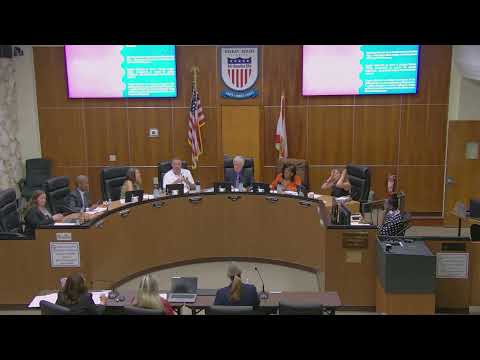
The Delray Beach City Commission voted unanimously on March 31 to postpone for 90 days a re‑evaluation of off‑street parking requirements for Subculture Coffee, a popular cafe at 302 Northeast 6th Avenue.
The postponement came after a quasi‑judicial hearing in which city staff presented evidence that the cafe’s activities may have expanded beyond the “grab‑and‑go” use it described to the commission in 2023 and, under the city’s land development code (section 4.6.9), could require a larger off‑street parking allocation. Commissioners instructed the owner to provide a level‑one site plan from a design professional, complete required paving and striping to city standards, document arrangements to keep employees off‑site, and pursue a triparty off‑site parking agreement. Staff said it will coordinate with law enforcement and the Florida Department of Transportation on enforcement of long‑term on‑street parking.
Why it matters: The outcome keeps the business operating while the city and owner try to resolve a long‑running dispute about spillover parking and whether recurring events at the cafe changed the approved use. If the commission later finds the use has been reclassified as a “meeting place,” the code’s higher parking standard could require many more spaces than Subculture can provide on site.
City presentation and evidence
City Attorney Lyn Jillen told the commission the matter was not about shutting Subculture down but about ensuring the property complied with the terms of prior approvals. Jillen said the 2023 approval assumed customers would mostly stay 15 minutes or less, which justified a smaller in‑lieu parking requirement; staff now says some activity at the site looks like a “meeting place,” which is assessed at a higher parking rate. Jillen noted staff had documented events, open investigations and an open hardscaping/striping permit for the site, and she cited the code provisions that permit the commission to re‑evaluate parking when the nature or manner of a use changes.
The city presented photographs and records and called Sergeant Matt Sarasini from the traffic unit, who said officers had issued citations for parking in a no‑parking zone but that much of the identified parking spillover occurred within private property bounds. ‘‘Outside of blatantly parking in front of a no‑parking sign, it wasn’t obstructing traffic,’’ Sarasini testified, adding that private lots remain the responsibility of the private property owners to enforce.
Owner’s response and data
Owner Rodney Mayo disputed the city’s characterization that the cafe primarily operates as a meeting place. Mayo told the commission he had suspended outside events while appeals were pending and presented sales and security‑camera counts he said showed the majority of transactions were takeout. ‘‘I don’t want to go through this and I don’t see it ever ending,’’ Mayo said, adding he felt targeted by a small number of neighbors. He also noted the practical limits of adding dozens of off‑street parking spaces at the tight site and pointed out the business paid $118,300 in April 2023 as an in‑lieu parking payment.
Public comment split, with many patrons urging city help rather than closure
More than two dozen people spoke during the public comment period. Customers, nearby residents and several business owners praised Subculture as a community gathering place and warned that a 44‑space requirement would effectively force the business to close. ‘‘This is one of the tiny places that feels like Delray,’’ a resident said, adding that the cafe provides a safe place to gather and that many visitors rely on it for community and workspace.
By contrast, two nearby property owners who submitted multiple complaints urged the commission to treat repeated parking impacts seriously. Neighbor Daniel Rose said his office and driveway had been blocked at times and said the frequency of his complaints reflected local impacts to his business. Another neighbor, Albert Rich Wagon(s), described repeated text complaints to police about parking near his property.
Commissioners seek a phased, practical fix
After extended discussion, commissioners emphasized a pragmatic, staged approach rather than an immediate reclassification. They unanimously moved to postpone the re‑evaluation for 90 days and instructed the owner to:
- Submit a Level‑1 site plan amendment prepared by a design professional that shows the maximum feasible on‑site parking configuration to current city standards (including required handicap access and double striping); - Complete required paving/striping work and close the hardscaping permit or otherwise document progress in the permitting system; - Demonstrate a plan that keeps employees from occupying customer spaces and pursue a triparty off‑site parking agreement (owner, city and third‑party lot operator) if additional spaces are needed; - Cooperate with staff’s efforts to work with FDOT and the police department on on‑street timed parking and enforcement for long‑term commercial vehicle parking on Federal Highway.
The motion passed on a 5–0 roll call vote. Deputy Vice Mayor Mark, Commissioner Malikica, Commissioner Cassell, Vice Mayor Burns and Mayor Carney all voted yes.
What happens next
Under the commission’s direction, staff will work with Mr. Mayo and return within 90 days with the owner’s site plan and documentation of the steps taken. If the owner does not complete the required items or the commission later determines the use has changed in a way that triggers additional parking, the commission could then assess a higher off‑street parking requirement or other remedies under the code.
Context and limits
The commission’s action focused narrowly on whether the property’s use and conduct have changed from what was described and approved previously. The 90‑day postponement is intended to produce engineering documentation and near‑term corrective work rather than to immediately reclassify the use or force closure. The issue remains technical (code interpretation, parking counts, and site geometry) as well as political: many speakers asked the city to find practical ways to support a small, community‑oriented business while protecting neighbors’ access to their private property.
For now, Subculture remains open while owner and staff work with city reviewers to deliver the required site plan, stripe the lot and pursue the off‑site/employee parking commitments the commission requested.