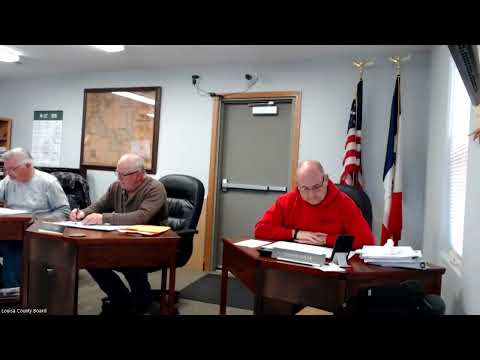
Louisa County sets April hearing on state-driven accessory dwelling rule changes
Summary
Louisa County supervisors set a public hearing for April 14 on proposed zoning ordinance 110.4 to align local rules with new state accessory dwelling unit (ADU) requirements, and discussed setbacks, size limits and conversion rules for mobile homes and RVs.
Louisa County supervisors voted to set a public hearing for April 14 at 9:00 a.m. on proposed zoning ordinance 110.4, which would update local rules to reflect new state standards for accessory dwelling units (ADUs). The board moved and seconded the hearing request during its April meeting and directed residents and stakeholders to attend and comment.
The county planning official told supervisors the draft language would largely retain standard front-yard and side-yard setback rules but would adopt state-based limits on ADU size relative to the primary dwelling. Under the state framework described to the board, an ADU is generally limited to half the square footage of the primary residence (for example, a 1,400-square-foot home would allow an ADU up to about 700 square feet), with caps that can permit larger units where an original dwelling exceeds the threshold. Mobile homes may be used as ADUs only if converted to real estate, and parcels with ADUs must remain a single tax parcel — the county will not allow lot splits to create separate ownership for the accessory unit.
Supervisors worried about practical questions raised by residents and building officials, including how existing permits interact with the new rules and permit thresholds for septic systems and conversions. "There are people applying now who think the state law removes all local permitting—then they find they still need permits," a planning official said during the discussion, noting ongoing uncertainty in how applicants interpret state guidance.
The county set the hearing to give residents a formal forum to comment on the ordinance language and to resolve those implementation questions. After the hearing, the board will consider any ordinance revisions before returning the measure for formal approval or rejection at a future meeting.
AI generated
The text on this page is AI generated. Summaries, highlights, analysis, and video transcripts are all produced from the original source material.
AI can make mistakes, so if you spot one, and we will fix it for everyone.
Note: the source content is unaltered by us. Any content source we link to, be it a video, an audio recording, or a document, is presented exactly as its publisher released it. That publisher is usually a government body, sometimes an individual official or another organisation.