Get Full Government Meeting Transcripts, Videos, & Alerts Forever!
Get email alerts on the Alaska Lng Tax Policy topic
No spam. Unsubscribe anytime.
Denali Borough finance committee reviews proposed state tax changes for Alaska LNG project
Summary
Committee members reviewed Senate Bill 280 and companion House Bill 381, which would replace current property-tax treatment for Alaska LNG infrastructure with a volumetric alternative; staff estimated Denali Borough could eventually see about $3 million annually but noted local receipts would be delayed by a multi‑year abatement period.
A staff member for the Denali Borough Finance Committee told members April 1 that proposed state legislation — Senate Bill 280 and companion House Bill 381 — would change how Alaska LNG infrastructure is taxed and could materially reduce near‑term property‑tax revenue for the borough.
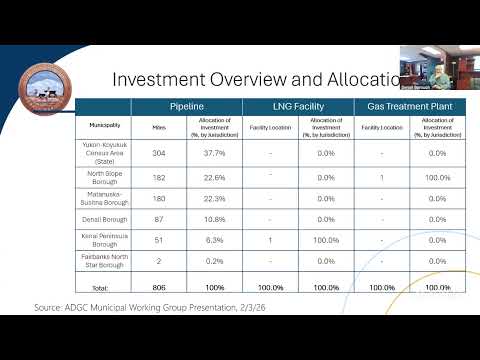
The matter matters to local taxpayers because the presenter said the Denali Borough accounts for roughly 10% of the pipeline miles (87 miles) in the project plan, with about 10 miles crossing borough land; under current law the state taxes such infrastructure at what the presenter called "20 mils" and municipalities may tax oil and gas infrastructure under the statute the presenter cited (referred to in the transcript as "4356"). The bills would create an alternative volumetric tax (AVT) roughly equivalent to a two‑mil rate — described as about "6 cents per 1,000 cubic feet" — and include an abatement period tied to either reaching 1 billion cubic feet per day of throughput or 10 years after commercial operations begin.
According to the presenter, the Department of Revenue fiscal note forecasts that during construction and the first few years there would be little or no local payment, with "full payment for the Denali Borough" estimated at about $3 million annually once the project is fully producing. The presenter also said the project’s total cost estimate is "currently at $44 billion" and referenced an "about $1.5 billion" figure for a portion of the pipeline during the discussion; the transcript does not further clarify the $1.5 billion figure.
Committee members discussed next steps, including whether the assembly should adopt a formal resolution stating a position on the bills. One committee member noted the Mat‑Su Borough has already passed a resolution on the legislation. The staff member said they have invited the Alaska Gasline Development Corporation (AGDC) to send a representative to next week’s full assembly meeting to provide a project overview and answer questions.
The staff member framed the central fiscal concern as timing and the tax base: the AVT as drafted would change the property‑tax equivalent and include ramp‑up protections that delay full municipal receipts for years, while the borough will still face direct land impacts from construction (the presenter estimated about 300 acres of pipeline easement on borough land assuming a 300‑foot right‑of‑way).
No formal motion or vote on the legislation occurred during the Finance Committee meeting; committee members asked staff to circulate written public comments and documents and to pursue the AGDC presentation for the assembly meeting. The assembly may consider a resolution after receiving additional information and the AGDC briefing.