Get Full Government Meeting Transcripts, Videos, & Alerts Forever!
Get email alerts on the School Policy topic
No spam. Unsubscribe anytime.
Board debates bell‑to‑bell personal‑device policy for K–8 as policy committee seeks clearer language
Summary
The policy committee reviewed proposed Policy 237 on personal electronic devices: draft would restrict K–8 under a bell‑to‑bell rule and limit high‑school use during instruction; board members and students raised questions about hearing‑aid carve‑outs, wearables, transportation, extracurricular events and enforcement; drafters will revise language and return to the committee.
The Hatboro‑Horsham policy committee reviewed proposed revisions to Policy 237 (personal electronic devices) at the March 9 work session, including a recommendation to apply a bell‑to‑bell restriction for grades K–8 and limited use for grades 9–12.
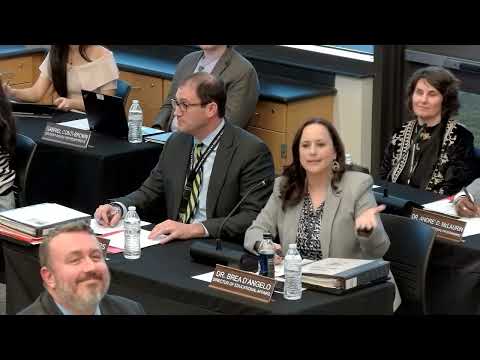
Dr. Bri D'Angelo described the proposed policy and said the district included a broad definition to cover cell phones, wearables and AI‑enabled devices so the rule remains applicable as technology evolves. She told the board the draft would allow exceptions for documented IEP and 504 accommodations and medical needs, and it would permit administrators to restrict device use during school‑sponsored activities if necessary. "Bell‑to‑bell cell phone policy would mean that cell phones are away. You can't use them from the start of the school day, the bell, to the end of the school day, the bell. They nowhere to be found, nowhere to be seen," a presenter said while explaining the legislative concept under discussion.
Board members and student representatives raised multiple implementation questions: whether the bus ride home counts as instructional time (presenter: it does not), how wearables and hearing aids will be treated, whether teachers retain discretion to use phones for instructional purposes, how policy enforcement will fit within the student code of conduct, and whether dances or after‑hours events are covered. One board member urged carving out hearing aids explicitly after students and others said some assistive devices are personal and always on. Student representatives asked whether teachers could allow limited device use for classroom activities or breaks; Dr. D'Angelo said teachers may exercise instructional discretion where appropriate but the policy aims for clearer restrictions during instruction.
Committee members emphasized consistency and implementation planning. The committee did not adopt the policy at the work session; drafters were asked to meet with board members, student and parent representatives to clarify language (including hearing‑aid accommodations and how the policy applies to school‑sponsored activities) and to produce a revised draft for the next policy committee meeting and potential first read at the legislative meeting.
No public speakers registered during the community‑input period. The policy committee continues work on language and implementation guidance before bringing a revised policy to the full board.