Get Full Government Meeting Transcripts, Videos, & Alerts Forever!
Get email alerts on the Parks Rowing Club topic
No spam. Unsubscribe anytime.
Council memorializes rowing-club plan but delays fence requirement after finance, aesthetics concerns
Summary
The Cape Coral City Council voted to memorialize prior Committee-of-the-Whole guidance for a rowing-club site, but several members pushed to re-examine a concrete-fence requirement — citing the club’s limited finances, uncertainty about the exact fenced perimeter and neighborhood visual impacts. Council agreed to revisit the fence language at a Committee of the Whole meeting.
The Cape Coral City Council voted April 1 to memorialize the Committee-of-the-Whole discussion about permitting the local rowing club to use space at Tropicana Park, but the meeting revealed deep disagreement over a proposed concrete perimeter fence and the size of the area the club may use.
Councilmember Lehman, who pulled Resolution 85-26 for discussion, said she was concerned the plan would move forward without the bridge project needed to relieve nearby traffic and that the fencing language was unclear. “I pulled it because I had to start the widening of Cape Coral Parkway without the bridge being underway,” she said, arguing timing could create traffic chaos.
Several council members took issue with a line in the draft that used the word “preferably” to describe a concrete fence. Councilmember Laster said the term left the scope undefined. “I never heard the word ‘preferably’ in our discussions,” he said. Councilmember Long raised the club’s limited finances: after reviewing the group’s financials and speaking with its leader, he said, “there’s no way they’re going to be able to afford a concrete fence… they can definitely afford a chain-link fence with slats.”
The City Manager said administrative notes and legal review had been interpreted to require a concrete material if a fence were to be used under the directive taken at prior committee meetings. “If it’s going to be a fence based on the direction that was previously given… it has to be concrete material,” he said, but also acknowledged that the actual fenced area could be smaller than the 11,300 ft2 referenced in prior discussions.
Councilmembers focused on three linked questions: whether the city should mandate concrete (with its higher cost and visual impact), what exact portion of the overall 11,300 ft2 the club would actually need, and whether the city should delay finalizing the memorializing resolution until those details are resolved. Several members asked to move the fencing issue to the Committee of the Whole for further study; the council agreed by majority and carried the motion to memorialize the earlier Committee-of-the-Whole guidance while scheduling a follow-up discussion.
What happens next: Council directed staff to schedule the fence/perimeter discussion at an upcoming Committee of the Whole so members can review the club’s membership size, financial capacity and alternatives to a full concrete perimeter. The memorialization does not itself obligate construction or city funding.
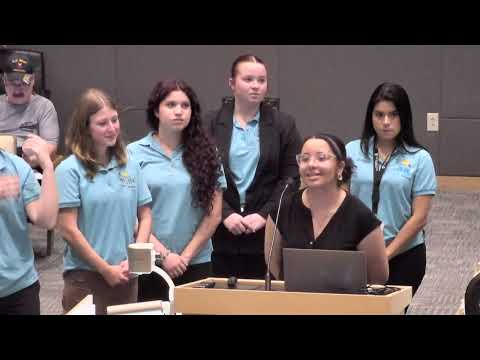
Why it matters: The choice of fence material affects costs for the volunteer-run club, the visual character of Tropicana Park and precedent for other user groups. Council members emphasized balancing neighborhood concerns, fiscal prudence and the youth-club benefits (scholarships and participation) described during the Youth Council presentation earlier in the meeting.