Get Full Government Meeting Transcripts, Videos, & Alerts Forever!
Get email alerts on the Beaumont Transit Plan topic
No spam. Unsubscribe anytime.
Presenter Ron outlines Beaumont’s 10-year transit plan, flags stop-accessibility gaps and seeks public priorities
Summary
City project staff presented a 10-year Beaumont transit study, reported student-centered ridership peaks, and highlighted that many of the system’s 129 stops lack basic accessibility; officials invited public input via surveys and a Mentimeter prioritization exercise.
Presenter Ron gave a Spanish-language briefing on a proposed 10-year plan to improve Beaumont Transit and asked residents to prioritize stop and service changes. The outreach presentation reviewed existing routes and frequencies, ridership trends since COVID-19, survey findings on rider demographics and barriers to use, and a stop inventory showing many locations lack basic boarding infrastructure.
Why it matters: the study seeks to make Beaumont Transit “more reliable, better connected and prepared for the future,” with a particular focus on students and low-income riders who form a large share of current users. Staff said recommendations developed from public input and a market assessment will be refined over the summer and presented to the city council for adoption later in the year.
The presenter summarized the network and service types: two weekday local routes, three peak-only school services, hybrid local/express lines serving employers and warehouses, commuter links to San Bernardino and a casino, and accessible paratransit service for riders with disabilities. Most fixed routes operate about hourly with limited evening service, and Saturday service was described as minimal; several services end around 6 p.m.
The team reviewed ridership trends, saying the pandemic caused a steep decline in 2020–21 and ridership has been recovering but not all pre-2020 services have been restored. Daily demand shows two clear peaks tied to school travel — a morning peak and a roughly 3 p.m. peak for dismissals — and notably lower demand on Saturdays.
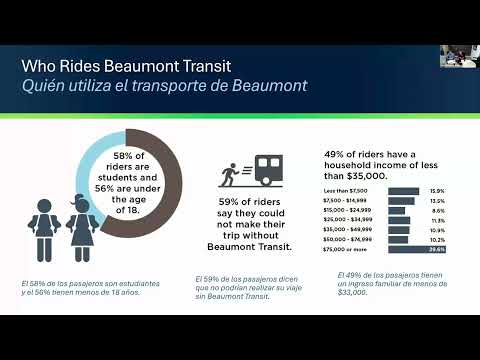
On demographics and reliance: the presentation reported that about 58% of observed transit passengers are students and roughly 56% are under 18; 59% of riders said they could not make certain trips without Beaumont Transit, and about 49% of riders reported household incomes under $33,000. Project staff described these figures as coming from onboard counts and a community survey of more than 400 households.
Stop infrastructure was a central finding. The team said Beaumont has 129 stops; 12 include benches and 23 include shelters or roofs, while a large share of stops were described as inaccessible — for example, narrow boarding areas, missing paved boarding areas, or no sidewalk connection. Staff reported 16 stops with no paved sidewalk or boarding area. To decide where to invest first, the project outlined six prioritization factors: frequency of use, safety and lighting, passenger comfort, accessibility for people with disabilities, equity across neighborhoods, and connection to major destinations such as schools, senior centers and medical facilities.
Project staff described prior outreach (five community events, a staff event on Dec. 13, and stops at the Walmart and high school) and an interactive exercise in which participants allocated limited resources to indicate which improvements they would prioritize. Attendees were invited to participate in a Mentimeter ranking exercise during the meeting and to submit comments via the project website or email. Staff said they will collect all survey and event input, complete a market assessment, develop preliminary recommendations in summer 2026, refine them with public feedback and then present final recommendations to the Beaumont City Council for adoption.
The moderator and presenter provided the project website and contact points for additional comments and closed the session. The presenter’s surname was not provided in the transcript.