Get Full Government Meeting Transcripts, Videos, & Alerts Forever!
Get email alerts on the Transportation topic
No spam. Unsubscribe anytime.
Lewis County rejects proposed speed‑limit increase on Bunker Creek Road after strong local opposition
Summary
County engineers recommended raising a segment of Bunker Creek Road to 30 mph based on an engineering study, but commissioners voted to not approve Ordinance 225 after residents and business owners urged crosswalks, enforcement and lower limits for pedestrian safety.
Lewis County commissioners declined to approve a proposed speed‑limit change on Bunker Creek Road after a public hearing in which business owners and residents urged the board to prioritize pedestrian safety over an engineering recommendation.
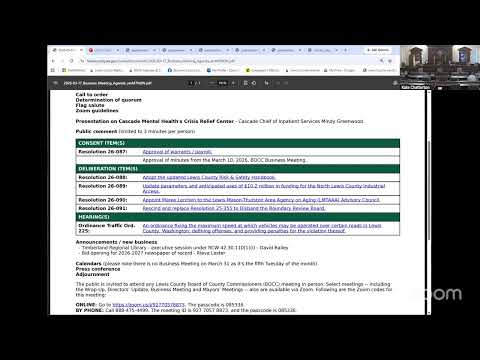
County Engineer Wes Anderson recommended Ordinance 225, asking the board to set a 30‑mph limit on a roughly 0.93‑mile stretch of Bunker Creek Road based on an engineering and traffic investigation that used the 85th‑percentile operating‑speed methodology. Anderson recommended amending the proposed limit to extend to milepost 1.1 (the start of a horizontal curve) after additional counts showed a local 85th percentile around 36 mph near the curve.
Several local business owners and residents testified against raising the posted limit. Jim Smith, who said he and his wife own the Adna Grocery, urged marked crosswalks at the rails‑to‑trails crossings and a crosswalk at the grocery because children and event crowds frequently cross the road. "I'd like to see a crosswalk ... at the ADNA grocery. We have a lot of kids that ... cross that road," he said.
Tony Turwilliger, who identified himself as owner of Adna Floral, said he has called for extra patrols repeatedly and described multiple close calls during his 23 years in business. "You raise it to 30, people are going to do 40. It's just human nature," he said, adding that property owners in the affected stretch oppose a speed increase.
Other commenters—parents, school‑area neighbors and church members—asked the board to consider 25 mph or school‑hour reductions, install speed‑feedback signs, mark crosswalks and increase sheriff patrols. Several speakers said machine traffic counts do not capture pedestrian volumes and event parking that create frequent on‑street activity.
Commissioners discussed enforcement and the legal defensibility of citations when posted limits deviate substantially from engineering‑justified speeds. Staff noted the traffic counter measured the 85th percentile at roughly 33.2–36 mph in the examined stretches (multiple studies over time ranged from the high 20s to upper 30s depending on location and season). Commissioners expressed interest in a community meeting, clearer crosswalk plans, speed‑feedback signage and additional enforcement before changing posted limits.
After deliberation, a commissioner moved that the board "do not approve Ordinance 225." The motion was seconded and carried 3–0, leaving the posted speed limit unchanged and directing staff and commissioners to pursue further outreach, crosswalk planning and nonregulatory traffic‑calming measures before reintroducing any change.
The hearing record includes written testimony and staff said it will return with any recommended follow‑up actions and cost estimates for pedestrian improvements.