Get Full Government Meeting Transcripts, Videos, & Alerts Forever!
Get email alerts on the Land Bank topic
No spam. Unsubscribe anytime.
Land Bank director outlines history, limits and plans for collaborations
Summary
Rachel Freeman, executive director of the Nantucket Land Bank, briefed the Planning & Economic Development Commission on the bank’s history, governance, statutory limits and a push toward collaborations for conservation, recreation, housing and mitigation.
Rachel Freeman, executive director of the Nantucket Land Bank, told the commission the land bank was born from local planning efforts in the early 1980s and is funded by a real estate transfer fee rather than a property tax. "My name is Rachel Freeman. I'm the executive director of the Nantucket Land Bank," she said, and summarized the agency’s origins, governance and statutory role.
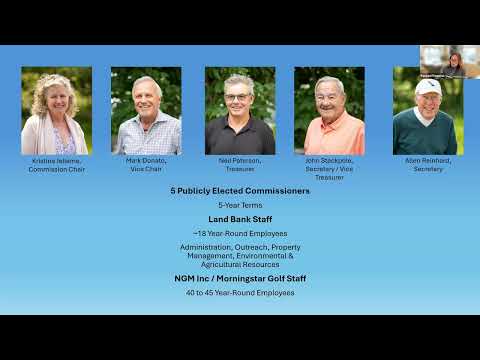
Freeman said the land bank was initiated from goals set in the 1983 balanced‑growth planning process and approved by voters and the state, and that the bank now owns roughly 3,500 acres. She described governance by five publicly elected commissioners and noted oversight by the state Executive Office of Energy and Environmental Affairs (EA).
Freeman emphasized statutory limits on the land bank’s authority. "We can't give away real estate interest in land," she said, explaining that any conveyance of property interests such as an easement or conservation restriction would require a two‑thirds vote of the state legislature. She also said the bank’s expenditures must align with its statutory purposes of conservation, recreation and agriculture and that it cannot fund projects that fall outside those purposes.
The presentation highlighted programs and collaborations the land bank is pursuing. Freeman described partnerships behind a venison processing and food‑hub program supporting Nourish Nantucket and the food pantry, recreation planning work with town agencies and other organizations, housing collaborations tied to open‑space parcels (for example, managing open space associated with housing projects and exploring employee housing), and expanded use of the bank’s mitigation expertise for town projects.
Commissioners pressed on next steps. Freeman said the bank does not yet have a completed strategic plan and is seeking public feedback and assistance from consulting firms to develop one. On eligibility to run for land bank commissioner, Freeman said she believed residency is required and that staff would confirm the precise legislative language. On whether the bank could support an indoor recreation facility, Freeman said the bank’s current policy specifies outdoor recreation and that a move to support a building would require commission policy changes and additional state approvals under section 6 and related processes.
Why it matters: the land bank controls substantial conserved land on Nantucket and its choices about acquisitions, partnerships and policy will shape public open space, mitigation capacity and potential housing and recreation outcomes. Freeman framed the bank’s future as one of collaborative public‑benefit projects carried out within statutory limits.
Next steps: Freeman said the bank will seek public feedback as it crafts a strategic direction and that commissioners and staff will return with further details and potential policy or legislative steps as proposals develop.