Get Full Government Meeting Transcripts, Videos, & Alerts Forever!
Get email alerts on the City Budget topic
No spam. Unsubscribe anytime.
Council presses OMB on $5.4 billion remaining gap as administration outlines $1.7 billion in potential savings
Summary
At a Finance Committee hearing, OMB Director Sharif Sulleman said chronic underbudgeting left large gaps in six major programs and defended the administration’s preliminary plan while Council leaders pushed for more detail on identified savings, vacancy alignment and alternatives to a property-tax increase.
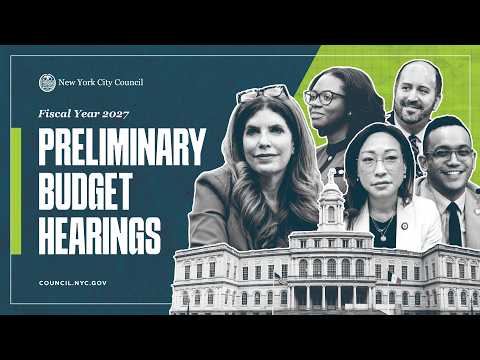
The New York City Council’s Finance Committee spent hours questioning the Mayor’s Office of Management and Budget about the administration’s fiscal year 2027 preliminary plan, focusing on a remaining $5.4 billion gap, agency underbudgeting, and OMB’s effort to validate roughly $1.7 billion in proposed savings.
"Raising property taxes is not on the table," Speaker Julie Menon told the committee in opening remarks, restating the Council’s aversion to a tax increase even as the administration included a preliminary proposal that would raise the average property-tax rate. The remark set the political frame for much of the questioning that followed.
OMB Director Sharif Sulleman defended the administration’s approach, telling the panel that a thorough review of agency cost centers found "significant underbudgeting had in fact occurred" across social services, education, shelter and other program areas. Sulleman said the preliminary financial plan reflects roughly $14 billion in agency expense adjustments over two years to bring budgets in line with known costs.
Council leaders pressed for specifics. Chair Linda Lee cited the Council’s own analysis that had identified "nearly $1.7 billion in potential revenue and savings," including a vacancy-alignment exercise covering about 12,000 positions budgeted but unfilled. Sulleman responded that agencies’ chief savings officers submitted proposals that total more than $1.7 billion and that OMB has so far validated about $200 million as bookable savings while the rest remains under review.
Members drilled into categories OMB says it is pursuing: contracting and procurement efficiencies, technology modernization, space consolidation and reestimation of prior-year payables and receivables. Several council members pressed officials on the city’s heavy reliance on outside consultants—DOE was singled out in committee questions—and asked whether work could be insourced.
The hearing also spotlighted program-specific drivers of cost. OMB said Family Eviction Prevention Supplement (FEPS) likely contributed to a decline in families-in-shelter but noted rising single-adult shelter counts, making shelter reestimate costs a persistent pressure. Sulleman described six program areas (cash assistance, rental assistance, shelter costs, due process cases, judgments and claims, and MTA subsidies) where known costs exceeded prior budgets by billions over FY26–27.
On reserves, Sulleman said the prelim plan included a mix of standard budget actions, state assistance and a careful draw on reserves to meet charter-mandated balance requirements, while urging state-level changes to ease long-term pressure on municipal finances. Council members warned that drawing down rainy-day funds risks credit-rating downgrades and higher borrowing costs.
Process questions dominated much of the committee’s time: How will OMB validate agency savings? When will a consolidated list of chief-savings-officer proposals be shared with the Council? How soon will agencies be allowed to "hire up" once vacancy alignment is complete? Sulleman said OMB will publish validated savings as they are vetted and that the administration intends to reset payroll (PS) budgets to allow agencies to refill prioritized positions before FY27 adoption.
What’s next: Council members signaled they expect more detailed documentation about validated savings and vacancy alignment before the executive budget, and multiple members asked OMB to provide breakdowns of proposed new positions and grant-claiming schedules. OMB said some information will appear in the executive budget, and staff emphasized that discussions with state partners about revenue options and reimbursement remain active.
The Finance Committee is scheduled to continue its review as agencies return for more detailed hearings and as the administration prepares the executive budget later in the spring. The committee made clear it will press OMB for line-by-line validation of the savings plan and for alternatives that avoid both deep service cuts and broad-based property-tax increases.
"We will continue to pursue our mission until we reach an agreement with the administration in June on a fiscally responsible balanced budget," Chair Linda Lee said at the hearing’s opening, underscoring the calendar pressure on both sides to resolve remaining gaps.