Get Full Government Meeting Transcripts, Videos, & Alerts Forever!
Get email alerts on the Education Budget topic
No spam. Unsubscribe anytime.
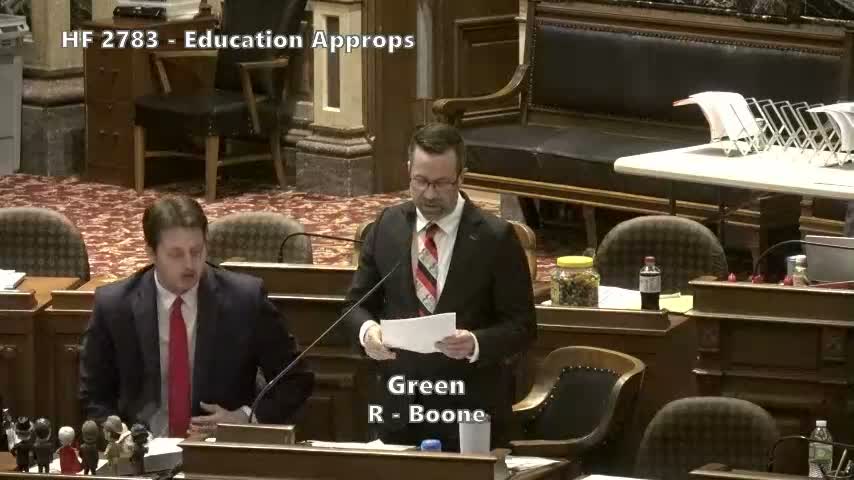
Senate passes education appropriations bill after floor debate over higher-education funding
Summary
The Iowa Senate voted to pass House File 2783, its FY27 education appropriations bill, after floor debate in which senators disputed whether the measure meaningfully increases funding for regents universities, community colleges and student supports.
The Iowa Senate voted to pass House File 2783, the FY27 education appropriations bill, after floor debate over whether the measure represents a meaningful investment in higher education.
Senator Green of Boone, sponsor of the bill, told colleagues the plan appropriates a little more than $1 billion from the general fund and funds 11,057 full-time equivalents for fiscal 2027. She highlighted targeted increases including about $3.5 million for community colleges, $10 million newly allotted to the special education division from the general fund, $335,000 to establish grants for advanced dyslexia specialist endorsements and $500,000 for school-district email security. She also said the bill renews $2.5 million in reorganization incentives that expired in 2024.
Supporters said the package responds to requests from local districts and community colleges. In final remarks, Senator Green said the budget includes about $121 million in new education dollars this year and that constituents prioritized K–12 and community college items.
Opponents said the bill falls short of what is needed. Senator Donahue of Linn said the bill “fails to invest in Iowa’s future,” charging it largely repackages existing dollars and shifts costs onto families and institutions. Senator Krombock argued the state’s regents universities have lost purchasing power relative to inflation, saying the system is roughly $165,000,000 behind his chosen benchmark and will face a continued erosion of purchasing power under the current plan. Senator Winkler noted Iowa’s low level of need-based aid—about $400 per public university student, he said—and warned that tuition burdens contribute to a long-term “brain drain.”
Several senators urged reallocations within the measure: Senator Weiner suggested shifting $1,000,000 from a less-used center to fund regents’ mental-health requests that could help retain students.
After debate, the sponsor moved that the bill be read for the last time and placed on its passage. The Senate agreed to the last reading, the title was agreed to, and the chamber proceeded to roll-call voting. The clerk recorded named votes including Senator Evans (aye), Alans (aye), Donahue (aye), Whitmer (aye), Townsend (nay), Rosenboom (aye), Webster (aye), Klemish (aye), Kreienbrink (aye), Costello (aye) and Dawson (aye). The presiding officer declared the bill had received a constitutional majority and it was passed; the Senate subsequently ordered the bill immediately messaged to the House.
The passage closes this stage of the budget’s legislative process in the Senate; the bill will be transmitted to the House as required under legislative procedure.