Get Full Government Meeting Transcripts, Videos, & Alerts Forever!
Get email alerts on the Zoning Rezoning topic
No spam. Unsubscribe anytime.
North Lake planning commission recommends reclassifying large rural lots to agricultural amid resident objections
Summary
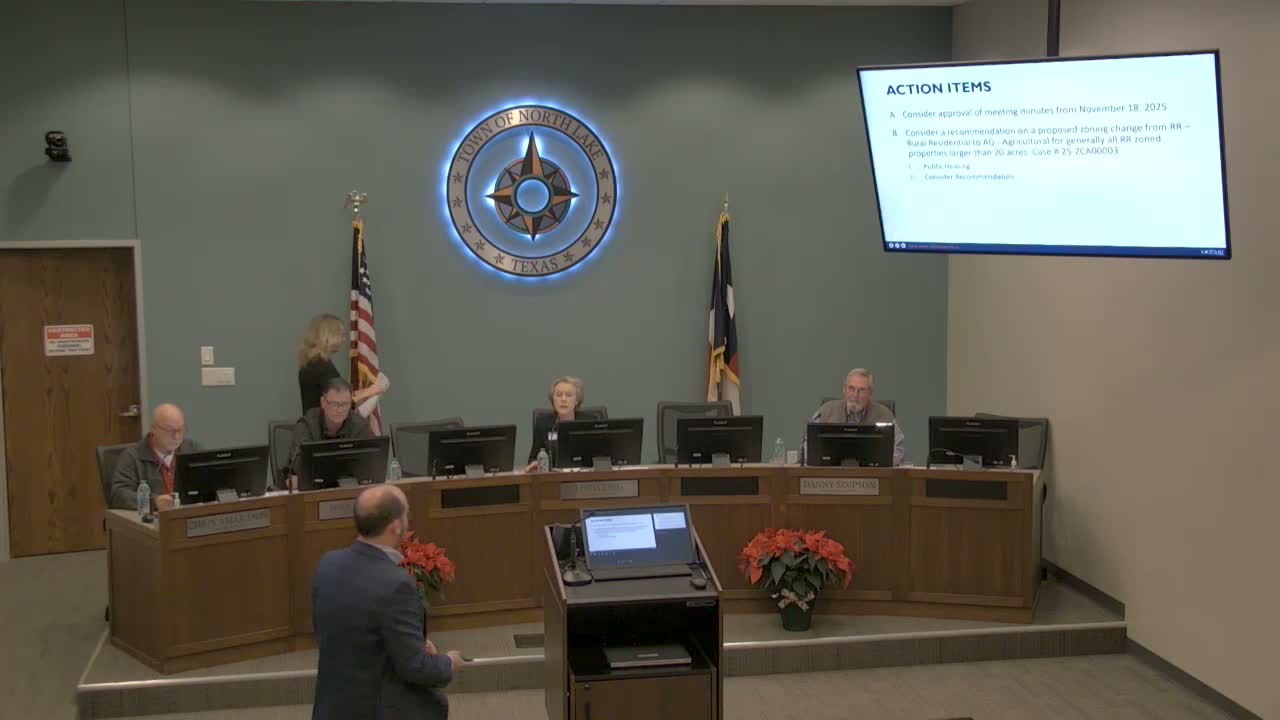
The Planning and Zoning Commission recommended approval of a town-initiated rezoning to Agricultural for undeveloped rural-residential parcels larger than 20 acres (Case 25‑ZCA3) after extensive public comment about setbacks, property rights and potential effects on schools; council will consider the change and a supermajority may be required.
The North Lake Planning and Zoning Commission on a majority vote recommended that the town reclassify undeveloped rural‑residential parcels larger than 20 acres to an Agricultural zoning district, a town‑initiated rezoning staff said is intended to preserve larger lots and align zoning with the comprehensive plan.
Nathan, planning staff, told the commission the Agricultural district was adopted by ordinance in October 2022 and is being proposed as the default base zoning for large, undeveloped parcels so the town can better implement its comprehensive plan. "The AG zoning is more commonly used as a holding zone and this would help reduce some confusion or false impression that 5‑acre residential lots are planned in some of these areas," Nathan said. He added that single‑family homes remain allowed in the AG district and that higher setbacks reflect the larger minimum lot size (20 acres).
The presentation and subsequent public hearing drew multiple residents who said the change would restrict longtime property‑owner rights and could be used to block future public projects. "You're taking us from a position of certainty to a position of uncertainty," Kevin Brannon, who said he lives on Holder Road, told the commission. Rena Hardeman, another resident, said the rezoning would substantially increase setbacks and impose new permitting and design standards, calling the change "essentially a taking" of property in her view.
Opponents also raised concerns that the AG designation would prevent public schools from locating on certain sites. "In AG, it's not allowed at all," one commenter said, asserting that a public school that might be allowed under rural residential would be prohibited under AG. Nathan responded that public schools and other more intensive uses would still require a separate rezoning or special‑use process; he also said many large properties already have agricultural tax exemptions and that zoning alone does not automatically change tax status.
Commissioners pressed staff for clarifying details about what rights, if any, property owners would lose and whether the rezoning would itself create an immediate pathway to higher density. Nathan said any development to increase density would still require a property‑owner‑initiated rezoning and board approvals. He also noted that some mailed notifications were reissued after an earlier mailing error and that written opposition now appears to represent roughly 23% of the affected land area — a share that, if accurate at council, would trigger a supermajority requirement for council approval.
After discussion, a commissioner moved to recommend approval of Case 25‑ZCA3. The chair announced, "Motion carries with a vote of 3 4 1 against," and staff confirmed the item will proceed to the Town Council for its public hearing and final decision. Because of the expressed opposition by area, council approval may require a supermajority threshold in accordance with the town's notification rules.
What happens next: the council will hold its public hearing on the rezoning at the date staff noted (Thursday night, per staff) and then decide whether to adopt the change; staff told the commission that recommending approval requires only a simple majority at P&Z, but final council action may require a supermajority if area‑based opposition thresholds apply.