Get Full Government Meeting Transcripts, Videos, & Alerts Forever!
Get email alerts on the Homelessness topic
No spam. Unsubscribe anytime.
Regional providers tell Charlottesville council homelessness is rising; leaders discuss interim encampment responses while Center of Hope, Holiday Drive move on
Summary
At a May 4 Charlottesville City Council session, regional homelessness providers reported increases in unsheltered and sheltered counts, detailed shelter capacity and prevention efforts, and urged coordinated interim action for river encampments while longer-term projects such as Holiday Drive renovations and the Salvation Army’s Center of Hope advance.
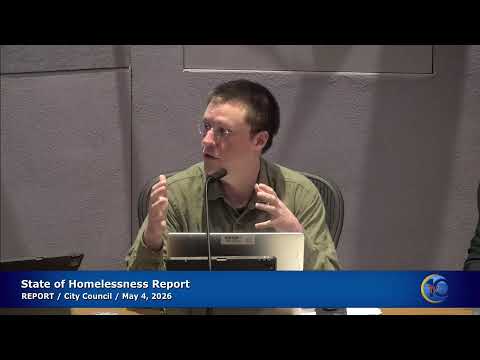
Charlottesville — Regional homeless‑service providers told the City Council on May 4 that homelessness in the catchment area has increased over the past year and that limited affordable housing and rising rents are straining shelter capacity and services.
The providers — led by Shayla Washington, executive director of the Blue Ridge Area Coalition for the Homeless (BRAC) — gave the council an annual "state of homelessness" briefing. Washington said BRAC’s by‑name list was 333 in the presentation draft and rose to 335 by the time of the meeting, and that regionwide homelessness measured roughly 620 last year versus about 703 this year. BRAC runs the HUD‑designated regional Continuum of Care and coordinates the Point‑in‑Time count used for federal reporting.
The data‑quality limits Washington described include incomplete locality reporting and self‑reported origins for many clients; she said BRAC has hired a grants and data manager to improve reporting. On the PIT night discussed, organizers hotel‑placed 87 people and counted seven people sleeping unsheltered during a severe weather event that complicated outreach.
Cindy Chambers, deputy director of PACHA (People and Congregations Engaged in Ministry), outlined cold‑weather shelter operations and a newly required Mental Health First Aid certification for most staff. Chambers said PACHA served about 246 adults this year (with roughly 30% chronically homeless) and described greater needs among older adults, substantial health and behavioral‑health comorbidity among guests, and ongoing private funding of a secure‑housing program that provides up to $1,500 in move‑in support.
Owen Brennan, executive director of The Haven, gave service metrics for the day‑shelter and coordinated entry system (about 26,000 visits annually, roughly 70 per day). He said the Haven’s rapid‑rehousing program receives $150,000 a year (about half federal, half state) and that prevention funding of $100,000 was available; together with private fundraising the organizations supported an emergency hoteling response that sheltered 109 people over 18 days during an extreme winter event.
A Salvation Army representative updated the council on a planned Center of Hope shelter campus, saying the capital campaign is about 59% complete and the group is aiming for a 2027 groundbreaking with an 18–24 month construction timeline. A councilor noted the state budget included more than $9 million for the Center of Hope, which the Salvation Army said would help advance the project.
Much of the council’s questioning focused on encampments along river corridors and public trails. Providers and city emergency responders described safety and environmental risks: a police representative said patrols logged 63 calls for service tied to encampments between January 2025 and late April 2026, including violent and high‑risk incidents; fire officials said they visit the sites multiple times per week and flagged high fire risk where propane heaters and improvised cooking are common.
Councilors pressed whether interim solutions are feasible before permanent projects are online. BRAC and partner organizations discussed a direct‑to‑housing consulting proposal from outside firms (Clutch Consulting/Community Solutions) that the Continuum of Care estimated at roughly $3–$4 million; BRAC said the board paused that work to prioritize the low‑barrier shelter opportunity at Holiday Drive and because multiple large initiatives are competing for local fundraising. Providers said a single outreach worker cannot manage large encampments and that any interim hoteling or site‑management effort would require dedicated project management and staffing.
Council action at the meeting was procedural: after presentations and discussion the council voted by voice to convene a closed session under Virginia Freedom of Information Act provisions for consultation with counsel on legal matters, potential litigation, security of City Hall, and potential property acquisition by the Charlottesville Redevelopment and Housing Authority. The council planned to reconvene its open meeting at about 6:30 p.m.
What’s next: providers asked the council to identify which phase of Holiday Drive renovation the city will fund and whether the city can clarify interim usage and code approvals for the site. Several councilors urged expedited operational planning for encampment safety and an accountable project lead if the city pursues interim housing or a direct‑to‑housing initiative.
Quotes
"A CoC does not cause homelessness. A COC is responsible for what happens after. When the total count grows, the cause is almost always upstream — rent, wages, evictions," BRAC’s Shayla Washington said.
"If we are focusing on the encampments as they are right now...someone's gonna die out there," one councilor said, pressing for faster interim action.
Ending
Councilors and providers agreed to continue planning and data collection and to return with more concrete cost and staffing proposals; the council recessed into a closed session to address legal and property matters and expected to resume public business later in the evening.