Get Full Government Meeting Transcripts, Videos, & Alerts Forever!
Get email alerts on the Water Rates And Budget topic
No spam. Unsubscribe anytime.
Austin Water projects 7.8% FY27 rate increase, warns reserves will dip as $2.74B CIP continues
Summary
Austin Water staff told the Water and Wastewater Commission budget committee that a proposed 7.8% rate increase for FY27 (adding about $7.76 to the average monthly residential bill) is part of a FY27–31 forecast to support a $2.74 billion capital program and customer assistance expansion; the committee set June 11 for the next meeting and approved the budget schedule.
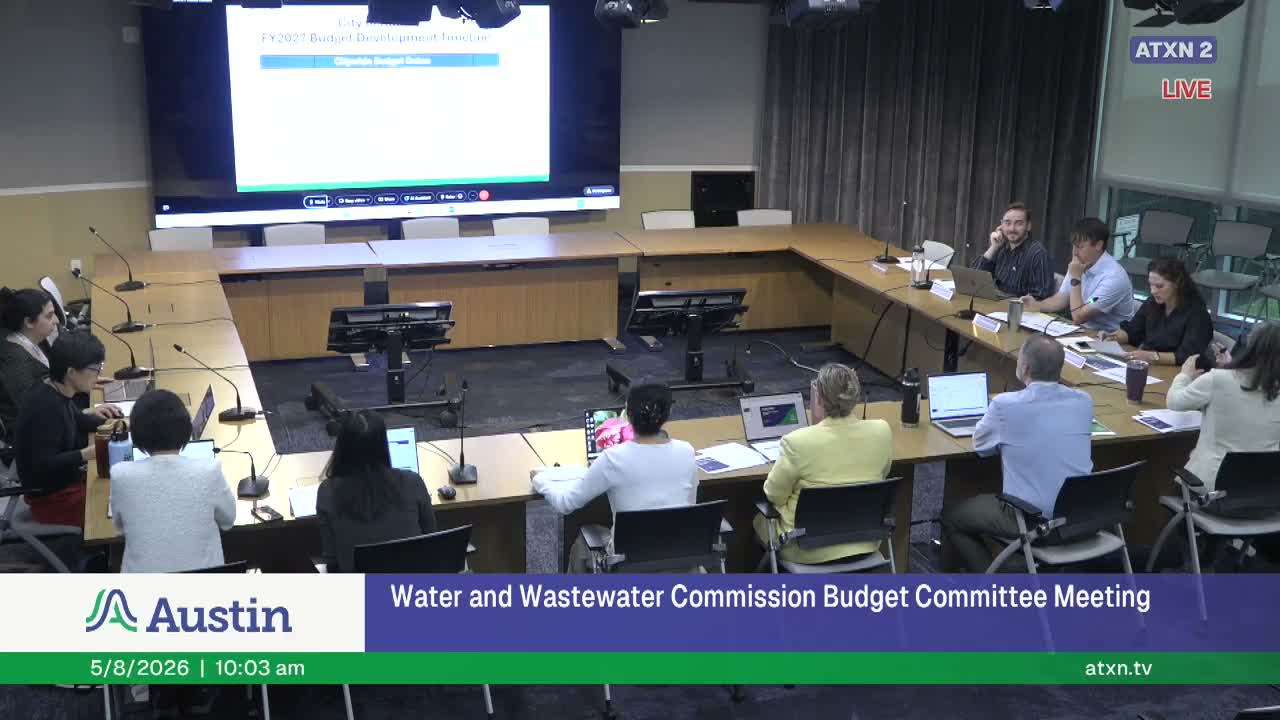
Austin Water staff told the Water and Wastewater Commission budget committee on the utility’s first FY27 budget subcommittee meeting that the utility plans a 7.8% rate increase for FY27 and a multi-year plan to stabilize financing for a large capital program.
"The 7.8% rate increase for '27 will add approximately around $7.76 to the combined average monthly residential bill," said Tina Romero, acting assistant director of financial services for Austin Water, describing the forecast that extends through FY31 and projects a cumulative rate increase of about 27% over the five-year window.
Joseph Gonzales, Austin Water’s deputy director for business services, reviewed the schedule and told commissioners the proposed budget will be submitted to the city budget office in mid‑July, with a council presentation set for July 16 and a narrow window afterward for the commission to prepare a recommendation. "That 13-day window is why we added another special commission meeting," Gonzales said.
Why the increases: staff said the capital improvement plan (CIP) is the principal driver. "The plan for fiscal year 2026 to 2030 totals $2,740,000,000," said Bridal Guo, capital assets accounting team manager, and she named the Walnut Creek wastewater treatment plant expansion as a major generational project in the program.
Staff said the forecast blends rising capital delivery costs, inflationary pressure, workforce investments and a sizable CIP. To manage borrowing costs, Austin Water has used defeasance and refundings that staff said generated about $746,000,000 in net present value savings. At the same time, slower development has reduced capital recovery fee revenue, limiting the amount available to defease future debt.
Affordability measures: Romero and other presenters emphasized programs to shield vulnerable customers. "We have a total of 63,000 customers that are receiving customer assistance and that's about 24,000 in residential and 39,000 in multifamily," Romero said, noting the assistance is funded by a community benefit charge set at 30¢ per 1,000 gallons. Staff did not provide a single-percentage figure for total enrollment at the meeting.
Credit profile and financial policy: presenters said Austin Water currently holds strong ratings (stable Aa/AA from major agencies) and described guardrails that affect rate-setting. Romero noted the utility’s financial policy sets a 1.75x debt service coverage target (the bond covenant floor remains 1.25x); Nam Nguyen, acting financial manager, said the utility uses 1.85x as an internal goal. Staff also said they plan to propose formal policy language to require 20% cash financing for very large generational projects rather than a flat 35% target in order to spread costs more equitably across current and future customers.
Outside funding constraints: Romero told commissioners Austin was recently told by TWDB that SWIFT program appropriations are exhausted and that state revolving funds are heavily oversubscribed, reducing external loan availability.
Next steps and committee action: commissioners asked staff to circulate the already-approved FY26–30 CIP early so members can review projects and cost changes before the next meeting. The committee set the next budget committee meeting for June 11 at 3 p.m.; a second July meeting at 3 p.m. was also placed on the schedule and the committee voted to approve the budget committee schedule unanimously among those present (Commissioner Pandarangi was absent). Staff said they will send the approved CIP plan to commissioners ahead of the next meeting.
The utility’s forecast and the commission’s discussion focused on balancing near-term affordability pressures with financing needs for long-lived infrastructure; staff emphasized the plan is conservative, weather-dependent and subject to refinement as the formal budget is submitted to the city.