Get Full Government Meeting Transcripts, Videos, & Alerts Forever!
Get email alerts on the Budget Deficit topic
No spam. Unsubscribe anytime.
Seattle school leaders warn of structural deficit and outline mix of one-time and ongoing fixes
Summary
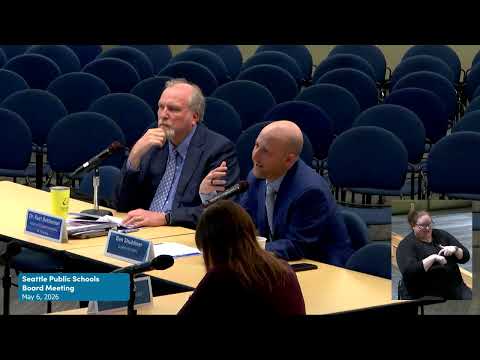
Superintendent Schulner and finance lead Dr. Kurt Buttleman told the board a multi-year structural deficit is draining the district's fund balance; officials projected an updated year-end fund balance near $55 million after refining estimates and outlined one-time revenue and structural savings to avoid hitting zero.
Superintendent Schulner told the Seattle School District No. 1 board at a special study session that the district faces a multi-year structural deficit and must take immediate steps to avoid exhausting its fund balance.
"The moment you hit 0, the game is over," Schulner said, describing a scenario that would force borrowing and could trigger state intervention. He showed a multi-year chart that, he said, reflects a drop in reserves from about $175,000,000 in FY22 for a roughly $1.35 billion budget toward a vulnerable projection if no action is taken.
Dr. Kurt Buttleman, who presented the projection assumptions, said the district's earlier projection of about $28 million for the end of the current year was based on last year's inputs posted to OSPI; newer information has led staff to refine that to roughly $55 million. "The 55,000,000 is what we're projecting now based on the new information we have," he said.
Why it matters: a $0 fund balance would require the district to borrow, a step that Schulner warned would carry serious operational and oversight consequences. Board members pressed staff for detail about how much of last year's fund-balance draw would actually be used this year and how the district expects to bridge the gap.
What officials proposed: staff outlined a mix of one-time and ongoing actions. One-time measures discussed include delaying repayment of an interfund loan (removing a planned $16,000,000 repayment from the near-term deficit) and pursuing an energy rebate under the Inflation Reduction Act tied to new facilities (staff estimated capturing up to about $12,000,000). Officials said the district used about $49,000,000 from fund balance last year but now expects to use closer to $29–39 million of that this year, leaving roughly $10–20 million for next year.
On the structural side, Buttleman and Schulner described ongoing savings: school staffing adjustments (presented as about $10,000,000 in savings), central-office realignments of a similar scale, potential transportation contract savings and other measures intended to be repeatable. "Some of the things that we're doing to balance the books are one-offs, and some are structural savings that will continue," Schulner said.
Staffing and mitigation: the presentation said the district mitigated about 28.9 FTE to schools through the staffing model change and committed to processes to place impacted certificated staff (e.g., vacancies, retirements, sub pools) where possible. Officials said they cut about 69.3 FTE from central office as part of the reorganization.
Equity and per-pupil variation: Schulner and Buttleman highlighted wide per-student spending differences across schools after excluding special education and multilanguage allocations, giving examples where some schools received about $9,000 per pupil while others approached $20,000. They also noted interagency program costs of roughly $51,000 per child, underscoring why leadership wants clearer, child-focused funding formulas.
Board response and next steps: directors praised the clarity of the packet and asked for follow-up detail on counselor ratios, how rounding to nearest FTE affects service levels at schools, the regional distribution of concerns and whether the K-3 class-size incentives produce net benefit. Buttleman said staff will bring more detailed FTE and allocation tables to upcoming meetings.
Procedural timeline: staff said they will present the public hearing and formal recommendations on July 8 and anticipate bringing the budget for vote at the August 26 board meeting.
The board did not take formal action at the study session; the presentation is intended to guide follow-up briefings and the public hearing process.