Get Full Government Meeting Transcripts, Videos, & Alerts Forever!
Get email alerts on the Solid Waste Contract Rfp topic
No spam. Unsubscribe anytime.
Committee recommends RFP for parishwide residential trash contract after staff outlines manual updates
Summary
Calcasieu Parish’s Solid Waste and Litter Abatement Committee reviewed proposed edits to the Solid Waste Management Manual and voted to recommend that the full Police Jury advertise an RFP for a five‑year residential solid-waste collection contract, citing priorities such as local customer service, operations dashboards and a tiered liquidated‑damages system.
The Solid Waste and Litter Abatement Committee recommended that the Calcasieu Parish Police Jury advertise a request for proposals for residential solid‑waste collection and disposal services after staff presented proposed revisions to the Solid Waste Management Manual.
At the meeting, Public Works presenter Mister Wainwright said the current five‑year curbside contract is in its final year and covers roughly 24,000 directly serviced homes and about 28,000–29,000 services overall. "It's about 7 and a half million dollar contract," he said, noting the contract touches nearly every parish household weekly.
Wainwright described the manual changes as largely organizational but highlighted several substantive priorities being carried into the next RFP: improving same‑day or same‑week recovery of missed pickups; requiring haulers to pre‑notify the parish and "proof the route" when introducing larger equipment; adopting a tiered liquidated‑damages approach based on the number of missed cans (under 100; 100–300; more than 300); and aligning definitions of "commercial solid waste" from the parish planning code into the manual, which could change how some mobile‑home parks are classified for service.
He also said staff will push for stronger local customer service options in the RFP so residents without account numbers can obtain cans or resolve issues in person, and for access to contractors' operations dashboards so parish staff can see live truck data and photos to speed problem resolution. "We want our citizens to be able to get onto a website or portal that works for them," Wainwright said, describing a customer service portal for scheduling bulk pickups and filing complaints as another RFP priority.
Wainwright said the manual will keep disaster‑response provisions used after hurricanes and other major events, including perishable‑goods satellite locations that are scaled based on storm impacts.
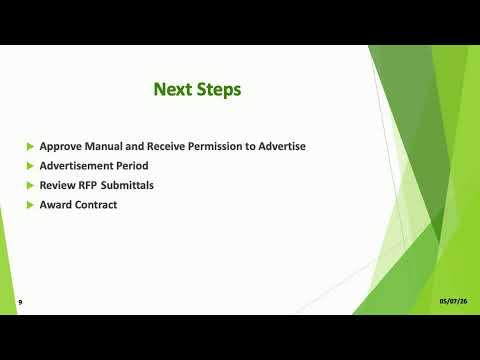
As for timing, staff said they would seek committee recommendation to the full jury, advertise the RFP, accept submittals and aim to have an assigned contractor in place in time for a five‑year contract beginning Jan. 1, 2027; staff estimated 60–90 days from advertisement to an assigned contract.
After the presentation and brief questions from a committee member about how perishable‑goods sites are listed in the RFP, the committee moved and seconded a recommendation to the full Police Jury to advertise the RFP. The chair called for objections and, hearing none, stated the motion carries.
The committee adjourned with staff to proceed to the next steps of manual approval and the RFP advertisement process.