Get Full Government Meeting Transcripts, Videos, & Alerts Forever!
Get email alerts on the Oath Review topic
No spam. Unsubscribe anytime.
WSBA task force chair outlines interim oath review; survey finds 54% of members favor change
Summary
Task force chair Rajeev Majumdar told the Washington State Bar Association governors an interim report and survey show 54% of members favor changing the attorney oath; the group has formed subcommittees, engaged tribunals and tribal stakeholders, and expects a detailed data breakdown on May 4.
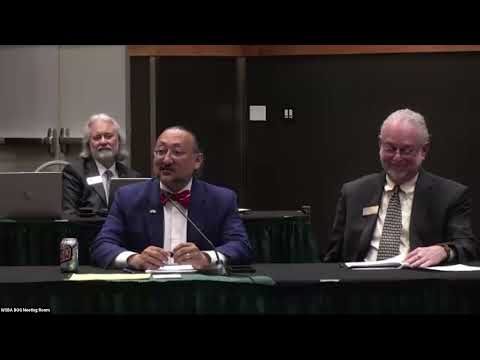
Rajeev Majumdar, chair of the Washington State Bar Association’s oath review and drafting task force, presented an interim report to the Board of Governors on the group’s work and next steps.
"I have filed a report. It is in your materials," Majumdar said, and summarized the task force’s outreach and early findings. He said the group launched surveys to sections, county bars and other constituencies and has been collecting historical and comparative materials about oaths.
The headline survey result, Majumdar told governors, was that "54% of all of the members are seeking a change to the oath or think would be a good idea to change the oath." He added that responses vary sharply by experience: lawyers with more than 31 years of practice tended to oppose changes, while newer lawyers were more supportive.
The nut of the task force’s work, Majumdar said, is to document the oath’s history, explain why changes are proposed and develop language that preserves core professional duties while addressing concerns that the existing oath is "confusing, archaic, or uninspiring." He reported the group has created subcommittees charged with refining language and proposing new phrasing and said he intentionally did not place three past presidents on those subcommittees "so there's no taint" that the Board of Governors controlled the process.
Majumdar named several subcommittee leads and outreach contacts, saying the task force had sought input across the profession: appellate court judge Rebecca Glasgow is running one ideas committee, and Roger Winn of the King County Prosecutor’s Office is leading a subcommittee focused on reforming oath language. He said the task force had also engaged section leaders, county bar associations and specialty bars in its outreach.
On judicial engagement, Majumdar said the group contacted district, superior and appellate judges across Washington’s eastern and western divisions, federal district courts in the state, administrative law judges and the Administrative Office of the Courts (AOC). "AOC has been sending a continual, observer delegate who has been very helpful in giving feedback and insight to us," he said.
Governors raised questions about whether certain oath language—specifically the phrase "I am fully subject to the laws of Washington"—could create problems for lawyers practicing in tribal sovereign jurisdictions. Majumdar said the task force is consulting Native-focused organizations, including the Northwest Indian Bar Association, and academic experts such as Monty Mills, a professor of Indian law, to examine those questions.
Majumdar acknowledged there are political concerns in the feedback. He said many qualitative responses suggested some members view the Bar as political: "The WSBA is a leftist political organization that is seeking to inject politics, into the oath," he said, attributing that line to survey respondents. Majumdar told governors the committee has discussed those concerns and is structuring work to avoid partisan language.
He said the task force requested staff-analyst help to break down survey results by county, practice area and years of practice, and that the data analyst’s report is expected on May 4. The task force will use that breakdown to inform the subcommittees’ proposals and then report back to the Board of Governors.
For now, Majumdar said the task force will prioritize answering the most-asked questions before addressing secondary topics such as whether different practitioner oaths (for lawyers, LPOs and others) should be unified.
Next steps: the task force will use the forthcoming analyst breakdown to refine recommendations and return to the Board with proposals developed by the subcommittees.