Get Full Government Meeting Transcripts, Videos, & Alerts Forever!
Get email alerts on the Land Use Vsp topic
No spam. Unsubscribe anytime.
Residents press Planning Commission over proposed Virginia Sports Park; commission defers decision
Summary
Neighbors raised safety, noise and water‑quality concerns during a packed hearing on a proposed sporting‑clays and archery park on Walton Road. Applicant presented a sound study and an environmental stewardship plan commitment; commissioners deferred action to March 19 to allow more study and conditions to be developed.
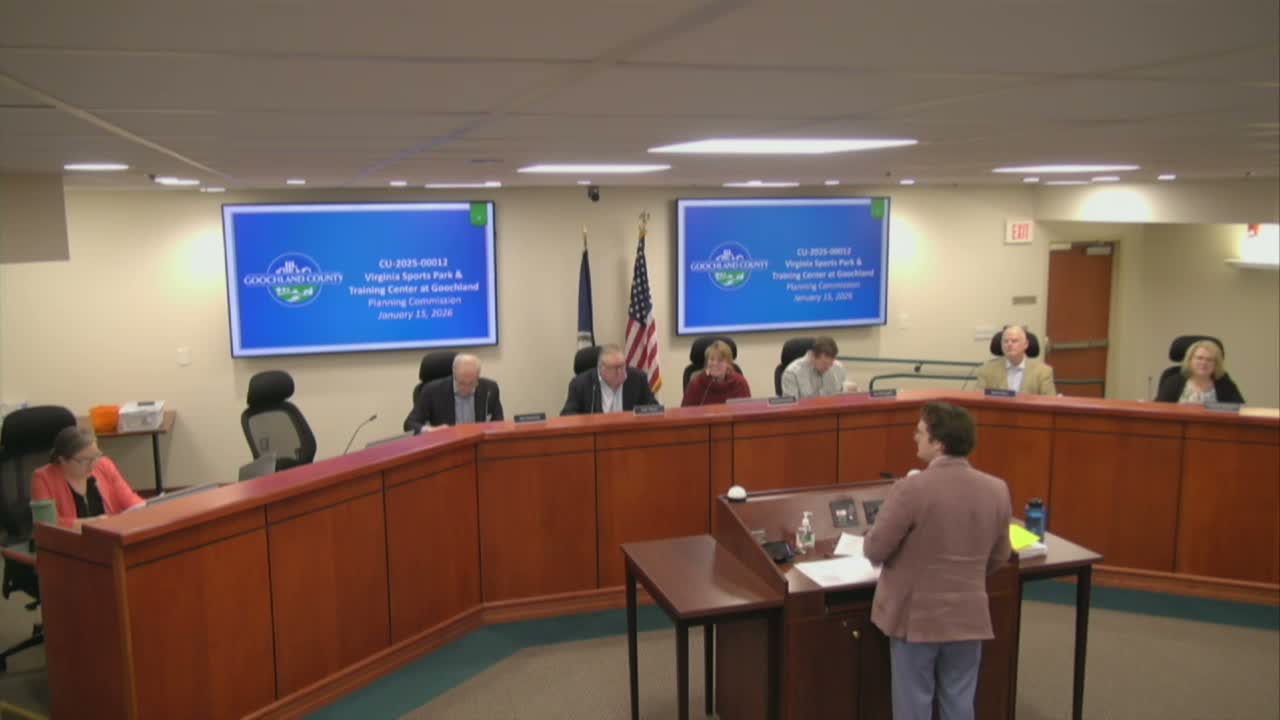
A packed Goochland County Planning Commission hearing stretched past midnight on Jan. 15 as residents, staff and the applicant debated a conditional use permit sought by Virginia Sports Park and Training Center (VSP) to operate sporting clays, trap and 5‑stand shooting, and archery on about 85 acres along Walton Road.
Ben Ellis, a county planner, told the commission that staff had identified a range of outstanding concerns — including shot‑fall zones that may overlap wetlands and floodplain, possible lead deposition and runoff into Deep Creek and the South Anna River, and unresolved noise and traffic impacts. Staff proposed 19 draft conditions including shot‑fall containment inside the CUP area, 8‑foot earthen berms, 50‑foot vegetative buffers, limits on ammunition size and on the number of tournaments, and a requirement that an environmental stewardship plan be submitted before plan‑of‑development approval.
Adnan Hamidi, director of VSP, said the organization is a nonprofit focused on sporting clays and archery. “We are not a gun range. We are sporting‑clays and archery sports park,” he said, adding that the group would follow state and federal rules on lead and submit an environmental stewardship plan as part of ongoing operations.
VSP’s acoustic consultant, Paul Thomas of Applied Laboratory Services, summarized a two‑hour field sampling effort and told the commission that decibel readings recorded during the demonstration ranged from roughly 22.1 to 52.4 dB, with an 8‑hour average at the highest sampling point of about 36.8 dB. Thomas said those averages were well below OSHA hearing‑protection thresholds and recommended additional monitoring over time if the commission moved the project forward.
Neighbors urged a different conclusion. Dozens of residents who live within a half‑mile of the proposed site said the scale and layout of the facility — with multiple shooting stations arrayed along the parcel perimeter — would place shot‑fall areas and lead deposition too close to wetlands, streams and homes. David Sisson, who lives about half a mile away, said mapping in a community impact report showed shot‑fall zones that “overlap with adjacent properties and homes” and urged the commission to “not accept that risk.” Katrina Dalton, who said she lives about 500 yards away, pressed for a formal ISO‑standard acoustic study, substantial setbacks, and a bond or surety that would pay for remediation if lead pollution occurred.
Speakers also raised traffic and timing concerns. Several neighbors asked for stricter limits on operating hours and the frequency of tournaments and special events; staff’s draft condition would limit firearms discharge to 9 a.m. to sunset Monday through Saturday, with no shooting on Sundays and a cap of 12 tournaments a year unless otherwise conditioned.
Throughout the hearing commissioners asked for more detail on shot‑fall containment, soil and wetland studies, the legal scope of the lease between VSP and the landowner (identified in the record as Luckstone/Luxstone/Lockstone in variant spellings), and for additional noise sampling with monitoring points closer to residences. Commissioners said those technical matters were central to balancing community welfare, the county comprehensive plan’s rural‑enhancement policies, and the applicant’s proposals for youth programs and economic activity.
After more than four hours of public comment and discussion, Commissioner Guy Kimmerle moved to defer consideration of CUP CU2025‑12 to the commission’s March 19 meeting to allow staff, the applicant and third‑party consultants to address the outstanding technical issues. The motion carried on a 4–1 roll‑call vote.
What happens next: the applicant will have time to provide additional studies and clarifications; staff indicated some items — such as a final environmental stewardship plan and plan‑of‑development review of shot‑fall containment and engineering — are tied to later review steps. The commission’s deferral leaves the CUP unresolved and scheduled for further consideration at the March 19 Planning Commission meeting.