Get Full Government Meeting Transcripts, Videos, & Alerts Forever!
Get email alerts on the School Facilities topic
No spam. Unsubscribe anytime.
RSU 40 seeks $24.9 million bond to renovate high school, citing asbestos, water and accreditation risks
Summary
RSU 40 officials proposed a $24.9 million bond to gut-renovate the district high school to remove asbestos, fix arsenic-contaminated water and replace aging HVAC and plumbing; state grants would cover portions of the work, district leaders said at a public forum.
RSU 40 officials on a recent public forum outlined a proposed $24.9 million bond to gut-renovate the district high school to address asbestos tile, nonpotable water and decades-old mechanical systems, and said state grants would cover a portion of the work.
The project team — architect Ann Keterer of Novo Studio and Carrie Worms of EEI — told attendees the plan focuses on three guiding goals: remediate health and safety hazards (including asbestos and arsenic in the water), optimize space for contemporary teaching and learning, and keep spending fiscally responsible. "We would remediate all 50,000 square feet of the asbestos tile," Keterer said, adding that the building is about 105,000 square feet in total and that the work would include new plumbing, electrical, ceilings and flooring.
Why this matters: district leaders said the building’s mechanical systems are at the end of their useful life, the water supply in the building is not potable due to arsenic levels "a little more than what we wanna see," and state reviewers raised concerns that could affect accreditation. Interim Superintendent Tom Ambrose said the building is "the most physically challenged plant I have ever worked in" and warned the district has postponed school operations because of water problems.
Project scope and grants: The district presented the $24.9 million total principal for the project and described a financing plan based on a 20-year bond. Worms said the state awarded about $4 million in revolving renovation funds to the district; roughly $2 million of those funds were identified for high-school items related to asbestos and water. Separately, the team identified a state asbestos grant of $1.5 million and a water-related grant of roughly $500,000. The district’s business administrator, Karen, told the forum borrowing will occur over three summer construction phases so final interest costs are not yet known.
Design and timing: If voters approve the bond (the district noted a June 9 approval milestone during the presentation), contractor work would be phased so disruptive work occurs in summers with schematic design, design development and construction documents completed beforehand; the team described major construction work occurring in 2027 and 2028.
Community concerns and responses: Multiple residents asked for line‑item costs, asked whether renovation is fiscally wise if the building might be replaced later, and raised worries about tax impacts on low-income residents. One attendee asked for assurance the renovation would not be wasted if the district decides to replace the building in a short time frame. Keterer and Ambrose responded that the building is structurally sound and that replacement would cost far more — "to build a new building would be $600 a square foot," Keterer said — and that the selected measures are intended to extend the facility’s useful life for decades rather than be short‑term fixes.
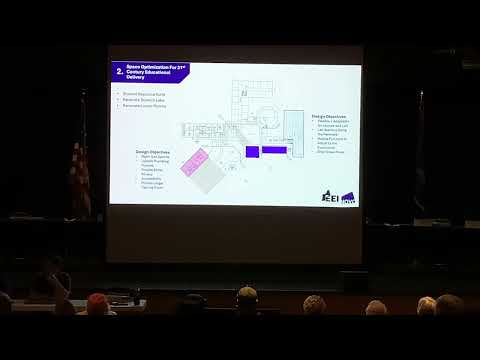
Technical choices: The renovation would replace nearly three decades‑old unit ventilators and a nearly 40‑year‑old boiler with a ducted energy‑recovery HVAC system and a central biomass plant using wood chips, which Worms said should reduce maintenance and operating costs if properly maintained. The team also proposed reconfiguring restrooms for ADA compliance and improved supervision, right‑sizing locker rooms, and moving science lab services to classroom perimeters to increase flexibility.
Next steps: The project team directed attendees to the district website for FAQs and presentation materials and said they would remain after the forum for more questions. The bond would require voter approval; if approved, the district plans summer‑phased construction across multiple years with final interest costs determined by the actual borrowing schedule.
Attribution: Quotations and specific technical claims in this article are taken from statements at the RSU 40 public forum by Ann Keterer (architect, Novo Studio), Carrie Worms (EEI), Karen (business administrator, RSU 40) and Interim Superintendent Tom Ambrose.