Get Full Government Meeting Transcripts, Videos, & Alerts Forever!
Get email alerts on the State Housing Package topic
No spam. Unsubscribe anytime.
State housing package briefed to Montgomery County committee; planners flag stacking and local impacts
Summary
Department of Housing and Community Development legislative chief Mr. Cook told the County committee the governor's housing package pairs production incentives, renter protections and a new financing vehicle; county planners said local rules and MPDU requirements will affect where state density bonuses apply.
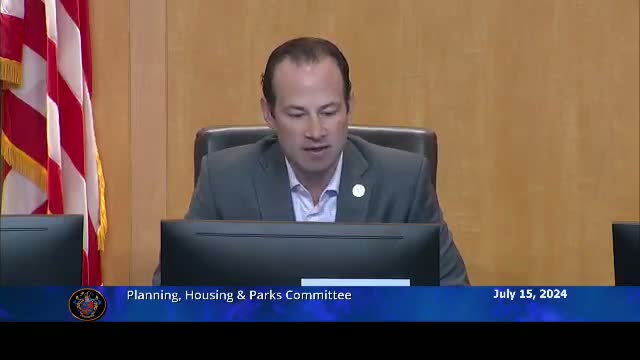
Mr. Cook, the Department of Housing and Community Development's legislative chief, briefed the Montgomery County Planning, Housing, and Parks Committee on three state laws the governor promoted this session: the Housing Expansion and Affordability Act (HEAA), the Renters Rights and Stabilization Act, and the Housing and Community Development Financing Act.
Cook told the committee the measures form a three-part strategy: "production, renters rights, and financing." He said Maryland faces a deep housing shortfall and that HEAA uses targeted density bonuses to encourage development near transit and on certain qualifying sites. "If you're within three-quarters of a mile of a passenger rail station and you include at least 15% affordable units at 60% AMI, you would receive roughly a 30% density bonus," Cook said.
Lisa Scavoni of the county planning staff said local moderately priced dwelling units (MPDUs) likely meet the bill's affordability definition (60% AMI with deed restrictions) and that many Montgomery County master-plan areas already require 15% MPDUs. Because of that, Scavoni said, projects in those areas may need to provide higher on-site affordability (about 20%) to reach state bonus eligibility. "We think MPDUs do fit under the definition of affordable," she said, describing the calculation that reconciles MPDU rent formulas with the bill's 60% AMI standard.
The county asked how state and local bonuses stack. Cook and planning staff agreed that local bonus would apply first to the base zoning and the state bonus would then be applied on top of that — effectively a bonus-on-a-bonus. Planning staff noted the state bill does not itself add additional height to reach the higher density, while local programs sometimes allow additional height to accommodate MPDUs.
Cook also described non-zoning elements of the package: the Renters Rights and Stabilization Act would establish an Office of Tenant and Landlord Affairs, cap security deposits at one month, and change eviction-filing procedures (he cited a Maryland eviction-filing rate materially higher than the national average) as ways to reduce eviction filings. The Financing Act creates a Maryland Community Investment Corporation to pursue new-market tax credits and other tools; Cook said the first MCIC meeting was July 3 and that the comptroller will chair early implementation.
Why it matters: The county's existing MPDU requirements and local bonus rules mean HEAA's benefits will be highly site-specific in Montgomery County. Officials said the state measures are intended to move other jurisdictions toward practices the county has already adopted, but local implementation choices (how to measure base zoning, how to allow height, and how to define qualifying projects) will determine real-world outcomes.
What's next: County planning staff and the committee agreed to continue coordinating with state staff and refine local guidance on stacking, height allowances and how MPDUs interact with the new state incentives. Cook said the Renters Rights provisions are phased (the financing act is already in place, the Renters Rights measures begin Oct. 1, and HEAA phases in on Jan. 1).