Get Full Government Meeting Transcripts, Videos, & Alerts Forever!
Get email alerts on the Bond topic
No spam. Unsubscribe anytime.
Berkeley council directs staff to craft single $600M bond and pauses parcel tax
Summary
After weeks of deliberation, the council directed staff to return with language consolidating previously separate measures into a single $600 million general‑obligation bond (roughly $300M streets, $150M housing, $150M other infrastructure) and continued related parcel‑tax action to a special meeting on Aug. 3 for final review.
The Berkeley City Council gave staff direction to revise fall ballot plans and prepare a single general‑obligation bond measure, asking that the city attorney and city manager redraft item language to reflect a $600,000,000 authorization and provide fiscal analyses for issuance options.
Mayor Aragon urged consolidation, saying a single measure could lower the total tax burden on homeowners compared with placing two revenue measures on the ballot. “We should give direction today, to proceed with 1 bond,” the mayor said as he outlined a proposed split of priorities: $300 million for streets/sidewalks/complete‑streets, $150 million for affordable housing, and $150 million for other infrastructure including utility undergrounding and civic projects.
Council members debated fiscal details, issuance pacing and whether the bond could legally and practically carry components originally proposed for a parcel tax. Public Works Director Liam Garland and the city’s municipal advisor reviewed options for drawing proceeds in tranches over 15–20 years and discussed how faster drawdown could be used to accelerate projects while repayment spans decades.
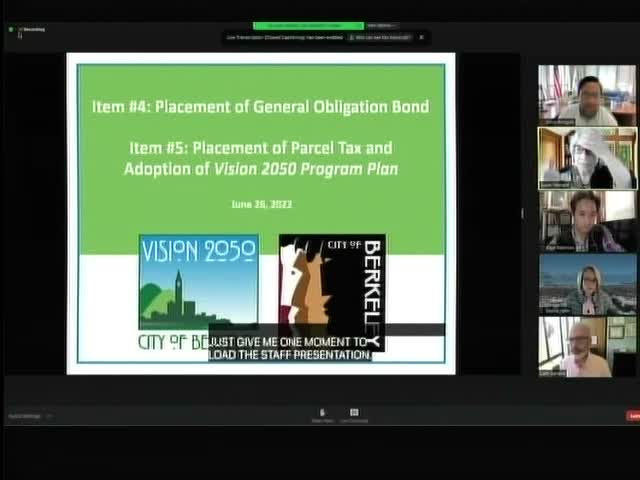
Council accepted several friendly amendments during the discussion, asked staff to analyze a $650 million option as an upper bound, and directed staff to deliver bond language, tax‑rate statements and a clear description of average taxpayer impacts before a special meeting scheduled for Aug. 3. The council also made clear it wants the Vision 2050 program plan updated to reflect the revised single‑bond approach.
The council voted to continue official action on the bond and to return with revised material and analyses; the continuation passed on a roll call vote. Council also took no action on the parcel‑tax item, noting the single bond direction would obviate that separate measure.
Council members and members of the public urged that any bond text include guardrails — clear allocations, oversight and possible debt‑service policy — to build voter confidence.