Get Full Government Meeting Transcripts, Videos, & Alerts Forever!
Get email alerts on the Solar Development topic
No spam. Unsubscribe anytime.
Boone County committee denies Cemetery Road solar special-use request after heated public opposition
Summary
The Committee of the Whole (Administration) voted against approving a 4.95 MW, ~40-acre Cemetery Road solar special use permit after extensive public comment and board questioning on farmland loss, drainage, stray voltage and enforcement; the motion failed 6–3 and will go to the full county board in two weeks.
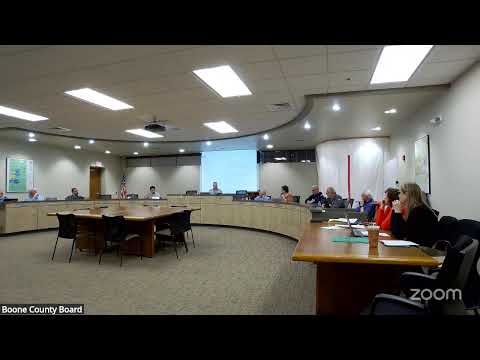
The Boone County Committee of the Whole (Administration) on May 7 voted to deny a special use permit for a proposed 4.95-megawatt commercial solar installation on about 40 acres along Cemetery Road in Gould Township, handing opponents a temporary victory but sending the application to the full county board for a final decision.
The committee considered special use permit 05-2026, which staff described as a revised version of a project originally heard in 2022. Staff said the Zoning Board of Appeals had recommended denial by a 3–2 split subject to amended conditions including a 36-month construction commencement deadline, underground electrical infrastructure, drain-tile mapping and protection, stormwater management and financial assurance for decommissioning.
The applicants — represented by attorney Jim Griffin and Nexamp project lead Matt Walsh — presented an updated site plan that reduced the number of poles, increased setbacks from Cemetery Road and the east property line, and proposed native, pollinator-friendly vegetation. Walsh said Nexamp has completed prior voltage studies and would perform drain-tile mapping and work with neighboring property owners during detailed engineering.
The meeting’s public-comment period featured several opponents. McKenna Farms descendant Mary Anne McKenna Moon said the parcel is prime farmland (LE 85.3 in the NRI report) and argued the county’s comprehensive plan discourages such conversion. Brent Mueller and others raised concerns about stray or “ground” voltage and livestock health; Randy Watson cited potential long-term loss of productive agricultural land and questioned developer motives.
Board members pressed the applicant on drainage, tile mapping, tornado and storm damage mitigation, road repair responsibilities and enforcement if panels are damaged or abandoned. Nexamp cited prior studies concluding the systems cannot cause stray voltage, described an emergency-response and complaint-resolution process with a 24-hour hotline, and pointed to code-based revocation or decommissioning remedies and insurance as enforcement tools.
Several commissioners voiced deep reservations. “Ever since I was on the board, every time you guys come up, I have voted no,” said a member during debate, citing repeated community objections and litigation history. On roll call the committee registered six votes against and three in favor; the motion to approve the SUP failed. The chair said the matter will be considered by the full county board in two weeks.
What happens next: Because the committee did not approve the permit, the full Boone County Board will take the final vote at its next meeting. The application remains unchanged in substance — if the full board approves, conditions recommended by staff and the ZBA would apply; if the full board rejects it, applicants may pursue legal options under state law and prior litigation history cited in the meeting.
Speakers quoted: “I respectfully ask you to pass a moratorium on new solar farm until the utility infrastructure is brought up to modern standards,” Brent Mueller told the committee during public comment. Nexamp’s Matt Walsh said the company would “work with the Boone County conservation district to help select the seed mixes” and that prior studies concluded “the system cannot produce stray voltage.”