Get Full Government Meeting Transcripts, Videos, & Alerts Forever!
Get email alerts on the Land Use topic
No spam. Unsubscribe anytime.
Developers propose 191-acre Montgomery plan with long-term mining and a future park; commissioners press engineering and floodplain safeguards
Summary
A developer presented a concept for a 191-acre, phased mixed-use development that would include a 15–25-year stone-mining operation whose reclaimed pit could become public recreational space; commissioners stressed concerns about floodplain compensatory storage, dewatering of private wells, truck access and the need for a binding developer agreement and reclamation guarantees.
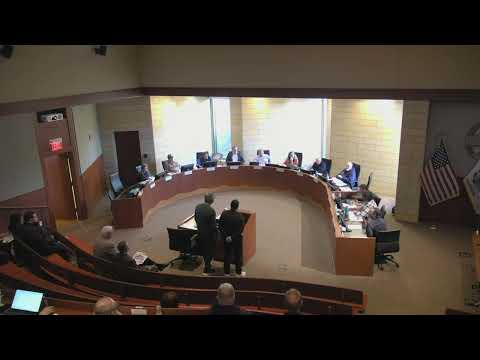
A team representing the owners of a 191-acre parcel north of Route 30 presented a concept plan to the Montgomery Plan Commission on May 4 that would pair commercial frontage and multifamily housing with a long-term stone-mining operation to generate material to raise buildable areas, then reclaim the mined pit as a public recreational amenity.
David Silverman, an attorney for the owners, said the proposal is three-pronged: commercial development along Route 30, multifamily housing on the east side (staff estimated roughly 300–340 units as an early estimate), and a mining operation expected to last about 15 to 25 years. Silverman said the owners’ current thinking is to donate the reclaimed lake and 20–30 acres of park-like amenities to the village or another public entity once mining and reclamation are complete.
Lead presenter Mike Schoppe (representing the project team) described engineering concepts: a 100-foot setback around the mining area, a perimeter berm approximately 12 feet tall to screen operations, and phased removal of topsoil to create fill that would raise the commercial and residential areas out of the floodplain. The team said initial site work would raise parcels near Route 30 and provide the compensatory storage needed to comply with floodplain requirements.
Commissioners and staff pushed back on several technical and long-term issues. One commissioner warned about shallow private wells north of the site and the potential for dewatering if excavation lowers local water tables. Officials also stressed the difficulty of meeting FEMA and state compensatory-storage requirements at both the 0–10-year and the 10–100-year design storms, noting that "if you only create 0–10 year storage, all of that storage gets used up in smaller storms and it's not there when you need it for a real flood," a commissioner said.
Other concerns included dust and noise management over a multi-decade mining operation, heavy-truck access (whether Kendall Pointe Drive or 5th Street should carry initial truck traffic), the capacity of nearby streets to handle truck loads, and the condition and functionality of an historic tile/storm-sewer system that drains toward the Fox River. Commissioners repeatedly urged the developers to prepare an engineering approach that demonstrates no adverse downstream impacts and to propose a developer agreement that binds reclamation, a closure plan and performance guarantees.
Commission feedback was mixed. Some commissioners praised the vision—noting the potential for a large future recreational amenity—while others said they were not comfortable approving mining in the absence of detailed hydrologic, traffic and reclamation agreements. One commissioner said they would be reluctant to support the mining component even if the engineering was strong, citing long-term uncertainty about truck traffic and flood risks.
Staff and the developer agreed on next steps: the concept review is advisory, and detailed engineering studies (hydrology, mining operations, haul routes, berm/overland-flow design) plus a binding developer agreement would be expected before any conditional-use or planned-unit-development approvals. The commission did not vote to approve mining as an entitlement; instead, it asked for detailed technical documents and a clear timetable and safeguards if the developers pursue zoning and special approvals.
The commission’s comments emphasized that any approval path should include: a developer agreement spelling out timelines and reclamation performance standards; an engineer-certified plan for compensatory floodplain storage and mitigations for well users; a dust-control and dust-monitoring program; and a traffic/haul-route plan with identified off-site improvements if heavy truck traffic is anticipated.
The concept will return to staff and the developer for further study and future formal applications if the owner chooses to proceed.