Get Full Government Meeting Transcripts, Videos, & Alerts Forever!
Get email alerts on the Zoning topic
No spam. Unsubscribe anytime.
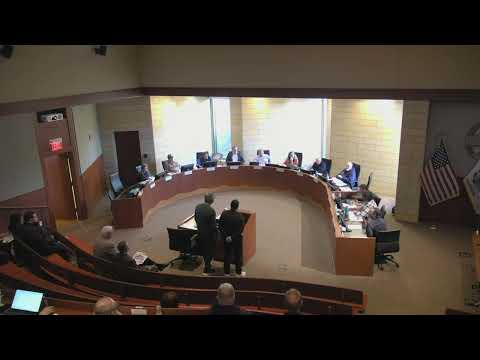
Plan commission backs JPC Tree Care expansion, limits open mulch piles to 10 feet
Summary
The Montgomery Plan Commission approved a special-use permit and façade variance for JPC Tree Care’s planned buildings and voted to amend the site’s outdoor-storage approval to cap open mulch piles at 10 feet, require an 8-foot fence where adjacent to residences, and require a looped water-main extension; items go to the village board on May 11.
The Montgomery Plan Commission on May 4 approved special-use and variance requests for Caldero Real Estate / JPC Tree Care at 1079 Sard Avenue and amended the business’s outdoor-storage permit to impose conditions intended to reduce dust and visual impacts on nearby residents.
Staff told commissioners the petition proposes two new 4,800-square-foot light-manufacturing buildings and a 2,400-square-foot paved area for material and equipment storage. The plan would add 16 parking spaces, new landscape screening, and fencing along lot lines; staff recommended approval conditioned on a final landscape plan, final engineering approval (including design, permit and construction of a water-main extension), and a recorded cross-access easement.
The petitioner, John Cordero, who identified himself as the owner of JPC Tree, said the company has grown over 14 years and needs additional covered space and storage to meet seasonal demand. "Last year we closed with almost $80,000 in sales taxes alone," Cordero said, describing three new covered buildings about 20 feet high that would enclose much of the material. He told the commission those buildings and newly planted screening would reduce visibility and nuisance to neighbors.
A resident, Scott Krantz, whose property is across the street, urged the commission to limit pile heights and beef up screening because "when you're in the backyard and the wind hits just right, you can feel some of the mulch coming over, irritating your eyes, and you definitely smell it," he said. Staff and the petitioner noted additional buildings, an upgraded fence line and plantings would address much of that exposure.
Commissioners debated fence height and storage limits. Staff noted the unified development ordinance allows up to 18 feet for stored materials as a code standard but the property’s existing special use had previously limited open-material stacks to 10 feet. One commissioner stressed infrastructure: "I think having a looped water main for the site is critical," and the commission added a looped-water-main requirement to the conditions.
A motion to approve both the special use and the façade-material variance advanced with conditions (final landscape and engineering approvals, water-main extension design/permit/construction, cross-access easement and adoption of findings). Separately, the commission approved the outdoor-storage amendment with these specific conditions: limit open piles to a maximum of 10 feet (with allowances for covered piles behind the new buildings), require replacement or installation of an 8-foot board fence along the residential lot line, and require design and construction of a looped water main to serve the development. The votes were unanimous; both items are scheduled for village board consideration on Monday, May 11.
The commission recorded concerns to be addressed in engineering review and recommended that any final approvals include clear conditions spelling out where taller, covered piles would be permitted and how screening and dust management would be enforced. The motion forwarded to the village board will include the staff conditions plus the added fence, pile-height and looped water-main requirements.
The commission did not adopt any emergency changes to code standards; the approvals rely on conditions in the staff report and the special-use amendment to constrain visible piles and require infrastructure improvements.